

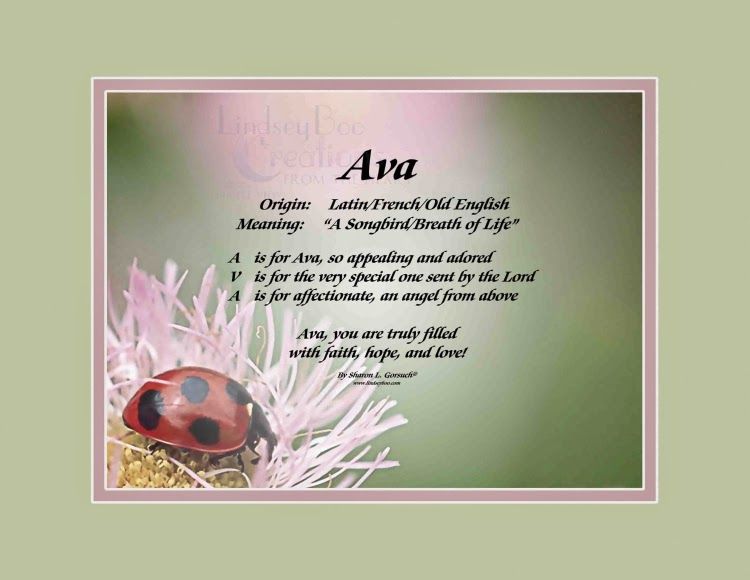
In the rich tapestry of biblical names, few evoke curiosity like Ava. This seemingly simple name bears layers of significance that resonate not merely within the boundaries of scripture but also in the broader context of culture, history, and spirituality. Its etymology and implications have stirred interest among theologians, historians, and individuals seeking personal connection to the divine. Consequently, unraveling the meaning of Ava in the Bible offers a glimpse into the interplay of identity, heritage, and divine purpose.
The name Ava, while not prominently mentioned in the canonical texts, is often associated with the Hebrew word “chava,” which translates to “life” or “living one.” This connection evokes the essence of creation and existence, attributing to the name a profound significance. It is important to note that names in the Bible are not arbitrary; they often reflect attributes or destinies. The implications of Ava as a name tied to life embody an underlying reverence for God’s creation and the vitality of human existence.
Furthermore, Ava finds its place in the lineage of names interwoven with divine narratives. In biblical contexts, names serve as verbal markers mapping out familial and spiritual connections. Consider the example of Eve—originating from the same root as Ava. Eve is revered as the “mother of all living” (Genesis 3:20), indicating the foundational role she embodies in the human story. In this light, Ava can be perceived as a modern reverberation of Eve, suggesting a continuum of life and spiritual legacy traced through generations. This genealogical thread invites individuals to contemplate the heritage inscribed within their names, irrespective of their theological affiliations.
Intriguingly, the name Ava has transcended its religious origins to attain prominence in contemporary society. As a popular name for girls in various cultures, it has garnered universal appeal. This phenomenon raises an essential question: What compels individuals across different backgrounds to embrace Ava? The answer likely lies within the inherent desire for connection—connection to a name that signifies life but also to a broader community that values names as symbols of identity and belonging.
The fascination with Ava is further amplified by its phonetic elegance. The soft consonance and lyrical flow of the name evoke a sense of grace and gentleness. Such qualities resonate with many parents when selecting names for their children, particularly in a world that often feels tumultuous and harsh. To name a child Ava, one invests in the hope that their life will reflect the grace and vitality encapsulated within the name. This aspiration echoes the biblical principle of bestowing names steeped in significance and intention.
Moreover, Ava finds resonance amid discussions surrounding femininity and the divine feminine. As the name is associated with life, it serves as an emblematic representation of nurturing, fertility, and female strength. In a time when the exploration of gender roles and the feminine divine is gaining traction, Ava stands as a reminder of the multi-dimensional aspects of womanhood intertwined with spiritual significance. This interpretation aligns with the broader themes within biblical texts that exalt women as key figures in the divine narrative, challenging historical marginalization.
The essence of Ava also invites reflection on the concept of life itself. In religious contexts, life is perceived not only as biological existence but as a divine gift imbued with purpose. This understanding can lead to an ethical conversation about responsibility in caring for life—in all its forms—due to its inherent sanctity. Such a philosophical underpinning encourages individuals and communities to engage in stewardship of the environment, social justice, and compassionate living, framing these endeavors as essential expressions of nurturing the life that Ava represents.
In contemplating Ava’s biblical connections, one may also reflect upon the breath of life bestowed by God—an essential element in the creation narrative. The Hebrew term “ruach” signifies the breath or spirit of God. This spiritual essence aligns closely with the meaning of Ava, weaving a narrative where life is not merely biological—it is rhythmically infused with the divine. This profound interrelationship urges deeper inquiry into how we perceive life, both in spiritual terms and through the lens of ecological responsibility.
As we consider Ava’s place within both the biblical milieu and contemporary society, an evident thread emerges—one of continuity, connection, and reflection on the essence of life. Whether through its linguistic roots, its embodiment of femininity and strength, or its representation of the imperative to nurture the world around us, the name Ava carries with it an invitation to delve deeper into the mysteries of existence. The desire to understand Ava transcends a mere curiosity—it is, at its core, an exploration of identity, purpose, and our collective responsibility to honor the divine intricacies of life. Thus, Ava stands not just as a name but as a reminder of the profound, interconnected web of existence we all share.
Ultimately, in the inquiry into what Ava means in the Bible, we uncover a microcosm of larger theological themes. The name serves as a lens through which we can analyze our spiritual inheritance, the essence of life itself, and an avenue for nurturing the world in which we reside. As we continue to grapple with these themes, Ava beckons us to embrace and celebrate the complexity of our existence.

