

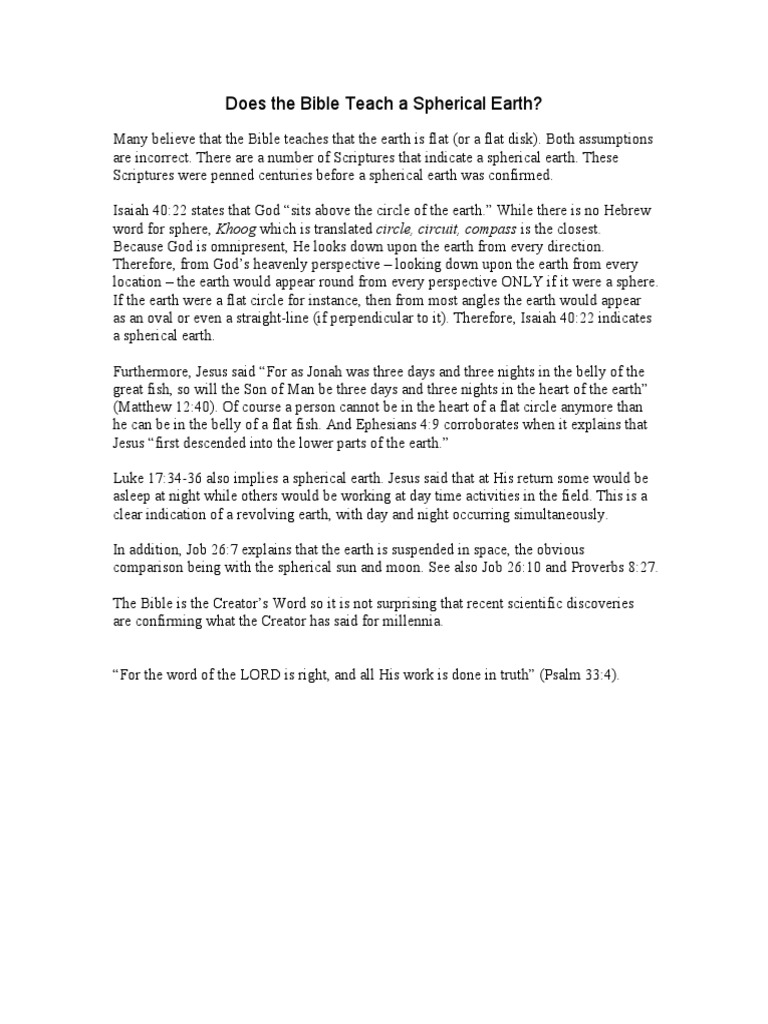
The intersection of faith and science often elicits fervent debate, particularly when it comes to ancient texts and the modern understanding of our planet. The Bible, a revered and historic anthology, contains passages that some interpret as hints towards the Earth’s shape. This exploration into scripture reveals not only theological insights but also a profound appreciation for the celestial sphere we inhabit.
To unravel the biblical perspective on the Earth’s shape, one might begin with the often-quoted phrase in Isaiah 40:22: “It is He who sits above the circle of the earth.” This nuanced depiction of a “circle” can evoke images of a vast celestial body, akin to a great disc spinning in the cosmic expanse. The term “circle” is intriguing; it lends itself to interpretations that align with both the Greek notion of the heavens and the more rounded, globe-like forms established by later astronomers. This textual imagery invites readers to imagine a divine vantage point, where the Earth is not merely flat but encapsulated within a grandeur that suggests roundness.
Another compelling reference is found in Job 26:10, where the text states, “He has inscribed a circle on the surface of the waters.” This metaphor resonates with the comprehension of both the Earth and its oceans, implying that the waters encapsulate a spherical domain. Such poetic language elevates the comprehension of the Earth, beckoning us to appreciate its three-dimensional nature amidst the expanses of the universe. It symbolizes the inherent curvature of the Earth, a notion that transcends simplistic interpretations of the world as a flat entity.
The duality of scriptural interpretation opens the door to a compelling dialogue between literalism and metaphor. Throughout history, some scholars have interpreted biblical imagery as not meant to convey scientific accuracy but rather to communicate profound existential truths. This dual approach allows believers and curious minds alike to engage in a rich tapestry of understanding—one that combines faith with rational inquiry.
Furthermore, the verses in Ecclesiastes 1:7 illustrate the cyclical nature of the Earth’s water—a reminder of the interconnectedness of all things. The movement of rivers and oceans reflects a system that transcends a mere flat surface. Such interconnectedness denotes a holistic view of creation, suggesting that the Earth, like a spinning wheel, is dynamic and perpetually in motion.
Moreover, Psalm 104:5 proclaims that “the Lord established the Earth upon its foundations, so it will never move.” This assertion emphasizes stability within the context of divine creation, promoting an image of the Earth as a secure, spherical foundation for life. The juxtaposition of earthly stability against a cosmic backdrop challenges the reader to contemplate their own existence within this magnificent sphere.
As we delve deeper, it becomes apparent that biblical texts often encapsulate a broader vision of creation—the Earth as a tapestry woven into the fabric of the universe. This perspective does not merely settle on the contention of shape but escalates towards the grandeur of Creation itself. The various passages deliver an invitation to explore the mysteries of existence, prompting humanity to ponder not only the physical dimensions of the Earth but also its spiritual significance.
In conclusion, whether one advocates for a literal interpretation or embraces a more metaphorical stance, the Bible provides a fascinating framework for contemplating the shape of our planet. The intertwining of faith, language, and science prompts a deeper understanding of both our physical and existential relationships with the world. Engaging with these ancient texts offers insights that are both profound and timeless, illustrating the multifaceted nature of God’s creation—an endlessly captivating sphere dancing through the cosmos.

