

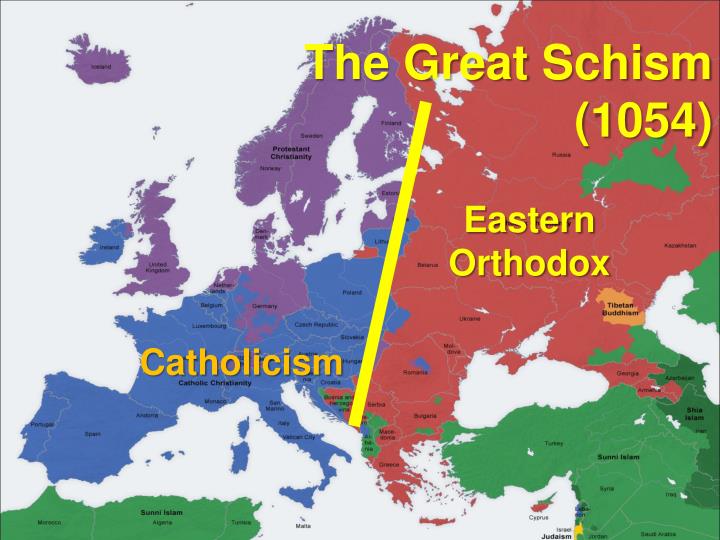
When the year 1054 arrived, a quiet storm broke over the Bosphorus, tearing a seam in the fabric of Christendom that had been stitched together over centuries. A single act of ecclesiastical diplomacy, swift and unadorned, sent ripples across the ancient world, leaving in its wake two rival heirs to a single promise. This is the story of the Great Schism—not merely a clerical dispute, but a dramatic rupture that reshaped theology, politics, and the collective imagination of believers east and west.
The Early Christian Unity: One Cloak, Many Threads
In the early centuries, the Christian church spread like a river, branching into countless local tributaries while still feeding a single ocean of belief. From the Council of Nicaea in 325 to the Council of Chalcedon in 451, bishops gathered in a spirit of collective discernment, forging a common creed that bound together Roman, Greek, Syrian, and Egyptian congregations. The Latin West and the Greek East shared the same sacred texts, sang the same hymns, and venerated the same martyrs, though subtle differences in language, ritual, and authority already hinted at an impending unraveling.
Seeds of Divergence: Language, Rite, and Authority
Even as the empire stretched from the Thames to the Euphrates, the linguistic horizon widened. Latin remained the tongue of the Roman see, while Greek flourished in the courts of Constantinople. Liturgical calendars diverged: the West celebrated the Eucharist with unleavened bread, the East with leavened loaves. Iconography, venerated in the East as a hierophanic portal to the divine, was viewed with suspicion in the West, where a more austere aesthetic took precedence. These seemingly minor variations created a slowly widening gulf, as each community began to see its own practice as the authentic expression of apostolic tradition.
Theological Fault Lines: The Filioque and Papal Primacy
At the heart of the tension lay two doctrinal disputes that would become emblematic of the schism. First, the Filioque clause—aLatin addition to the Nicene Creed stating that the Holy Spirit proceeds from the Son as well as the Father—challenged the Greek belief in the Spirit’s sole procession from the Father. The theological nuance, far from being a dry academic issue, resonated like a tremor in the foundations of Trinitarian thought, shaking the unity of the doctrinal edifice. Second, the question of papal authority: the bishop of Rome claimed a universal primacy over all churches, while the patriarch of Constantinople asserted a collegial model of mutual respect and shared governance. This struggle for ecclesiastical supremacy ignited a competition for loyalty that cut across cultural and linguistic lines.
Political and Cultural Tensions: Empires at Odds
Beyond theology, the political landscape fed the schism. The Byzantine Empire, teetering on the edge of decline, sought to consolidate its influence in the East, while the Holy Roman Empire in the West pursued its own ambitions. The papacy, ever keen to assert its temporal power, clashed with the Byzantine emperor over jurisdiction in Southern Italy and the Balkans. Meanwhile, the rise of the Bulgarian and Serbian churches added another layer of complexity, as new national identities sought to articulate their own ecclesiastical autonomy, further fragmenting the once-unified Christendom.
The Legatine Ultimatum: A Diplomatic Lightning Bolt
In the spring of 1054, the papal legate, Cardinal Humbert, arrived in Constantinople with a mandate to negotiate. Yet the negotiations quickly soured, turning into an uncompromising ultimatum. Accusations flew like arrows: the Greeks were charged with “Monophysite” sympathies, the Latins with “rationalist” innovations. The patriarch, Michael Cerularius, responded with a counter‑strike, publicly denouncing the Latin rites as heretical. The legate, deeming the patriarch’s response an insult to Rome,

