

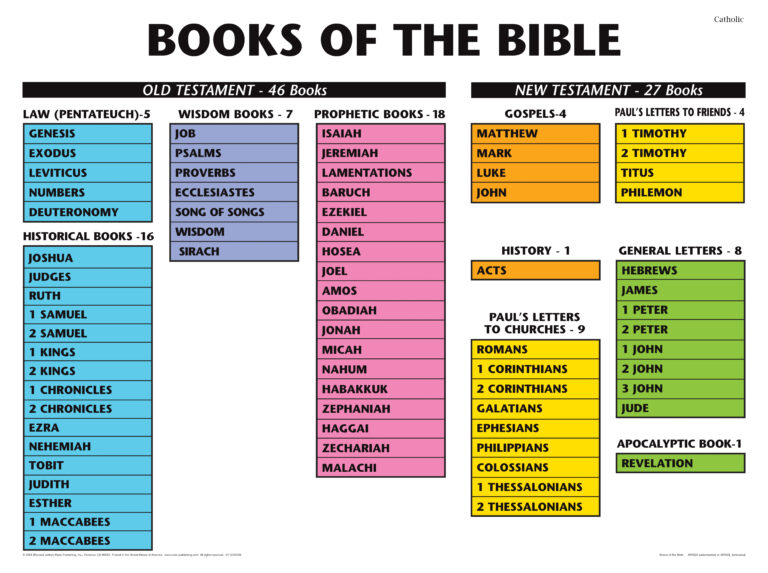
The Catholic Bible, a tapestry rich in history and theology, contains a collection of sacred texts that diverges significantly from its Protestant counterpart. This divergence can be likened to a vast library, wherein certain volumes are exalted and cherished only in specific realms of belief. Within these hallowed pages, the additional books unique to the Catholic canon beckon readers with their profound narratives, spiritual insights, and complex theological considerations.
At the heart of this distinction lies the Apocrypha, a term that etches a sense of mystery and intrigue. This group consists of seven books that are often viewed as outsiders in the broader Biblical canon. These texts—Tobit, Judith, Wisdom, Sirach (Ecclesiasticus), Baruch, and the First and Second Maccabees—are not merely additional narratives but rather vital threads woven into the fabric of faith, offering deeper understanding and insights into God’s covenant with humanity.
To embark on a journey through these books is to traverse a landscape where history and spirituality intersect. Take, for instance, the Book of Tobit. This narrative unfolds like a rich tapestry, highlighting themes of family, fidelity, and divine providence. Set against a backdrop of exile and suffering, Tobit’s quest to restore his sight serves as an allegory for seeking enlightenment amidst adversity. Readers are invited to ponder the delicate interplay between human agency and divine intervention.
Similarly, the Book of Judith stands as a testament to courage and faith. Judith, the valiant widow, becomes an archetype of strength, embodying the righteous struggle against tyranny. Her story is not merely a historical account; it resonates as a metaphor for the transformative power of belief. In the context of modern challenges, Judith’s battle is emblematic of the inner fortitude it requires to confront life’s many adversities.
Wisdom Literature, a treasure trove of philosophical musings, further enriches the Catholic canon. The Book of Wisdom offers profound reflections on virtue, justice, and the nature of God. Its poetic language dances across the pages, urging readers to embrace wisdom not just as knowledge but as a lived experience, akin to a radiant light illuminating the shadows of ignorance.
Equally compelling, the Book of Sirach encapsulates practical wisdom, much like a mentor guiding a disciple through the labyrinth of life. With its aphoristic style, it imparts nuggets of truth that resonate through the ages, urging believers to cultivate virtues such as humility, patience, and reverence. Each maxim serves as a stepping stone toward spiritual growth, inviting personal introspection.
In the historical narratives provided by the First and Second Maccabees, the reader is thrust into a time of conflict and resilience. These accounts do not merely recount the struggles of the Jewish people against oppression; they serve as a call to action for all who seek justice and freedom in the face of tyranny. They mirror the eternal struggle between light and darkness, informing the faithful of their shared heritage and the indomitable spirit of God’s chosen people.
The inclusion of Baruch further amplifies the poetic and prophetic voice within the canon. Baruch’s lamentation and call for repentance resonate deeply, touching upon themes of exile and hope. The text serves as a reminder that even in the darkest moments, redemption is possible, echoing the timeless truth that despair can be transformed into hope.
In summation, the additional books found within the Catholic Bible offer a unique appeal, weaving narratives that enrich the spiritual tapestry of faith. They invite readers into a deeper understanding of moral edicts, historical precedence, and divine revelation. The beauty contained within these texts is not merely in their stories but in their ability to shape the lives of believers, forging a connection to the divine that transcends time and place. Thus, they stand as a testament to the richness of Catholic tradition—an expansive library, ever welcoming the seeker of truth.

