

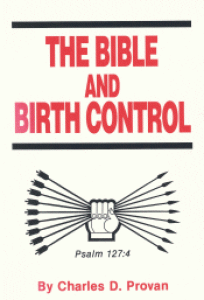
The topic of birth control often provokes animated discussions, particularly among those whose values are deeply influenced by religious texts. The Bible, a book revered by millions, does not explicitly address the issue of birth control. However, through an exploration of various scriptures, one can glean insights that reflect broader theological principles about family, sexuality, and the sanctity of life.
At first glance, a common observation about biblical texts is that they focus predominantly on procreation. The book of Genesis, for instance, presents the divine imperative: “Be fruitful and multiply, and fill the earth” (Genesis 1:28). This verse underlines the idea of human procreation as a sacred responsibility. Yet, the interpretation of this command can be nuanced, inviting deeper contemplation of what it means to form a family in today’s world.
One might argue that the emphasis on procreation inherently supports the conclusion that birth control is contrary to biblical teachings. However, while the act of bringing forth life is celebrated, the scripture also acknowledges the significance of responsible stewardship in all aspects of life. This includes the principles of love, commitment, and the well-being of both children and parents. The balance between the joy of parenthood and the preparedness for such responsibility is seldom addressed directly but resonates through various narratives and proverbs.
An engaging perspective can be drawn from the story of Onan in Genesis 38:6-10, where his refusal to fulfill his duty to provide offspring for his deceased brother’s wife is met with divine disfavor. While traditionally interpreted as an opposition to contraception, contemporary theological scholarship often suggests that Onan’s sin was not simply about birth control, but rather about failing to honor familial duties and responsibilities, thereby framing the discourse around intentionality and obligation.
The New Testament offers another dimension of reflection. In 1 Timothy 5:8, the apostle Paul states, “But if anyone does not provide for his own, and especially for those of his household, he has denied the faith and is worse than an unbeliever.” This underscores the critical nature of providing for one’s family. In modern contexts, this can imply that thoughtful planning regarding family size may be a responsible choice, aligning with scripture’s deeper moral priorities.
Moreover, the Bible reflects on the intrinsic value of each individual life. Psalm 127:3-5 proclaims that “children are a heritage from the Lord, the fruit of the womb a reward.” This sentiment amplifies the notion that each child is a divine blessing, intended to add to the joy of existence. Yet, one must also consider the implications of bringing a child into a less-than-ideal environment. The question of nurturing—spiritually, emotionally, and materially—often underscores the case for planned parenthood.
Interestingly, community perspectives play a significant role in the conversation about birth control within religious circles. Many faith communities grapple with the challenge of reconciling traditional pro-natalist views with contemporary societal realities. In congregations across the globe, dialogue about responsible parenthood burgeons, emphasizing the importance of both faithfulness to scripture and the necessity of compassion, understanding, and pragmatism in the lives of families.
In conclusion, while the Bible does not provide a clear-cut directive regarding birth control, it invites believers to contemplate deeper theological principles surrounding family, stewardship, and the sanctity of life. The interplay of scripture and contemporary living beckons individuals to navigate a path that harmonizes faith with the realities of life today. Thus, the decision regarding birth control often becomes not just a matter of dogma, but a nuanced journey of personal conviction, morality, and a commitment to fostering the well-being of family and community.

