

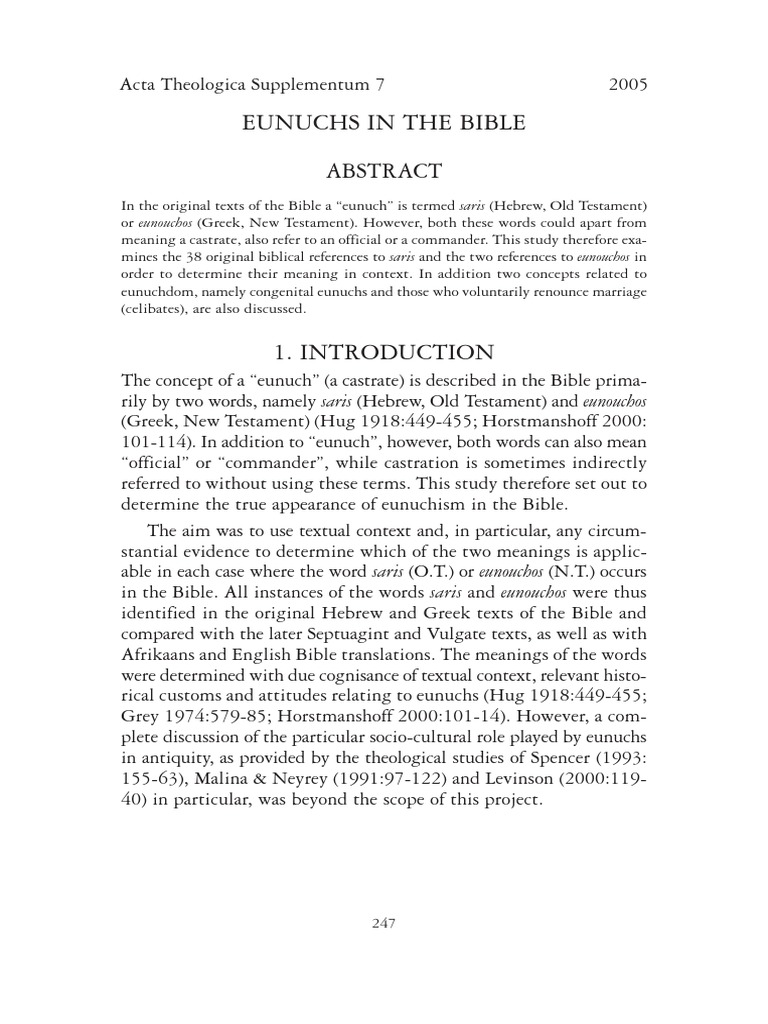
Eunuchs in the Bible emerge as multifaceted figures, steeped in historical, social, and theological significance. Their presence is not merely a footnote in ancient scripture but a profound testament to the diverse fabric of society during biblical times. Delving into the topic of eunuchs unveils a spectrum of roles and interpretations ranging from literal interpretations of castration to broader metaphysical constructs signifying devotion, service, and the reimagining of gender itself.
To fully grasp the meaning and implications of eunuchs, it is essential to explore several key areas: historical context, biblical references, typologies of eunuchs, their roles in society, theological implications, and contemporary reflections.
Historical Context
Understanding the status of eunuchs in biblical times begins with the acknowledgment of their unique function within various ancient cultures. Historically, eunuchs were often employed in royal courts, where they fulfilled roles that required a degree of trust and loyalty, often as guardians of harems or enforcers of the king’s will. This hierarchical placement positioned eunuchs at a paradoxical intersection of power and vulnerability, where they wielded influence even while existing outside the conventional structures of masculinity.
In ancient Israel, castration was viewed through a lens of social stigma, yet the biblical narrative echoes a more nuanced perspective. The cultural backdrop of the Near East offers insights into how eunuchs were perceived differently in various societies, from being revered in some instances to ostracized in others. The Israelites’ engagement with neighboring cultures shaped their own understanding and acceptance of eunuchs.
Biblical References
The scriptures contain several poignant references to eunuchs that illuminate their roles. One of the most notable passages is found in the book of Isaiah, where a direct promise is made: “Let not the eunuch say, ‘Behold, I am a dry tree,’ for thus says the Lord: To the eunuchs who keep my Sabbaths and choose the things that please me and hold fast my covenant, I will give in my house and within my walls a monument and a name better than sons and daughters” (Isaiah 56:3-5). This proclamation not only acknowledges the existence of eunuchs but also elevates their status in the eyes of God, essentially offering an affirmation of their identity.
Moreover, the New Testament includes references to eunuchs, particularly in the teachings of Jesus. In Matthew 19:12, Jesus distinguishes eunuchs as those who have made themselves eunuchs for the sake of the Kingdom of Heaven, suggesting a spiritual dimension to eunuch identity. This inward commitment elevates the discussion from a mere biological state to a broader, more profound understanding of devotion and sacrifice.
Typologies of Eunuchs
When discussing eunuchs, it is imperative to recognize their diversity. There are distinct typologies that emerge when examining their roles within the biblical narrative. These can be delineated into three primary categories:
- Royal Eunuchs: Often positioned in powerful roles within monarchies, these eunuchs held significant authority and influence. Their unique status allowed them to execute the king’s edicts while remaining above the intrigues of court life.
- Voluntary Eunuchs: As per Jesus’ teaching, these individuals consciously choose a life of celibacy for spiritual reasons. Their decision illustrates a transformative commitment to a higher purpose, transcending traditional gender roles.
- Unwilling Eunuchs: These individuals represent those who, through force or coercion, became eunuchs. Their narratives often evoke themes of tragedy and loss, illustrating the harsh realities faced in ancient societies.
Roles in Society
Examining the sociocultural landscape reveals that eunuchs occupied roles that differed across various strata of society. In many instances, they served as attesting figures to the intricate societal structures that tied power, gender, and servility together. Their ambiguous status allowed them to act as intermediaries within courts, where their lack of familial ties empowered them to navigate complex political ecosystems with a unique perspective.
Despite their notable presence, the societal perception of eunuchs was often marred by prejudice. Many lived on the fringes of society, facing a paradoxical existence where they could be both powerful and powerless. In Israel, the Mosaic Law explicitly excluded eunuchs from entering the assembly of the Lord (Deuteronomy 23:1), reflecting a stark societal delineation that further complicated their place within the community.
Theological Implications
The presence of eunuchs within scriptural texts invites profound theological reflection. The inclusion of eunuchs in divine promises reveals a radical rethinking of identity in light of faith. This breakdown of societal barriers foreshadows the inclusive nature of the Gospel message, suggesting that faith transcends physical limitations and societal constructs. Individuals once marginalized find themselves central to the redemptive narrative, which offers hope and potential for all, regardless of their circumstances.
Moreover, the discussions around eunuchs challenge traditional views of masculinity and gender roles, urging believers to consider the expansiveness of God’s grace that encompasses all facets of humanity. The biblical portrayal of eunuchs, therefore, exemplifies the kingdom’s radical inclusivity.
Contemporary Reflections
In the modern era, the discourse surrounding eunuchs remains relevant as society grapples with concepts of gender, identity, and belonging. The biblical understanding of eunuchs can be analogized to various contemporary experiences where individuals exist outside traditional gender binaries. The narratives of acceptance within biblical texts serve as prompts for empathy and understanding, challenging contemporary believers to reflect on how inclusivity is embodied in today’s church and society at large.
Thus, the exploration of eunuchs in the Bible transcends mere historical inquiry. It calls for a deep, reflective engagement with issues of identity, belonging, and the radical nature of grace. Eunuchs, once marginalized, are celebrated within scripture as harbingers of hope—a reminder that within the divine narrative, all are called to belong.

