

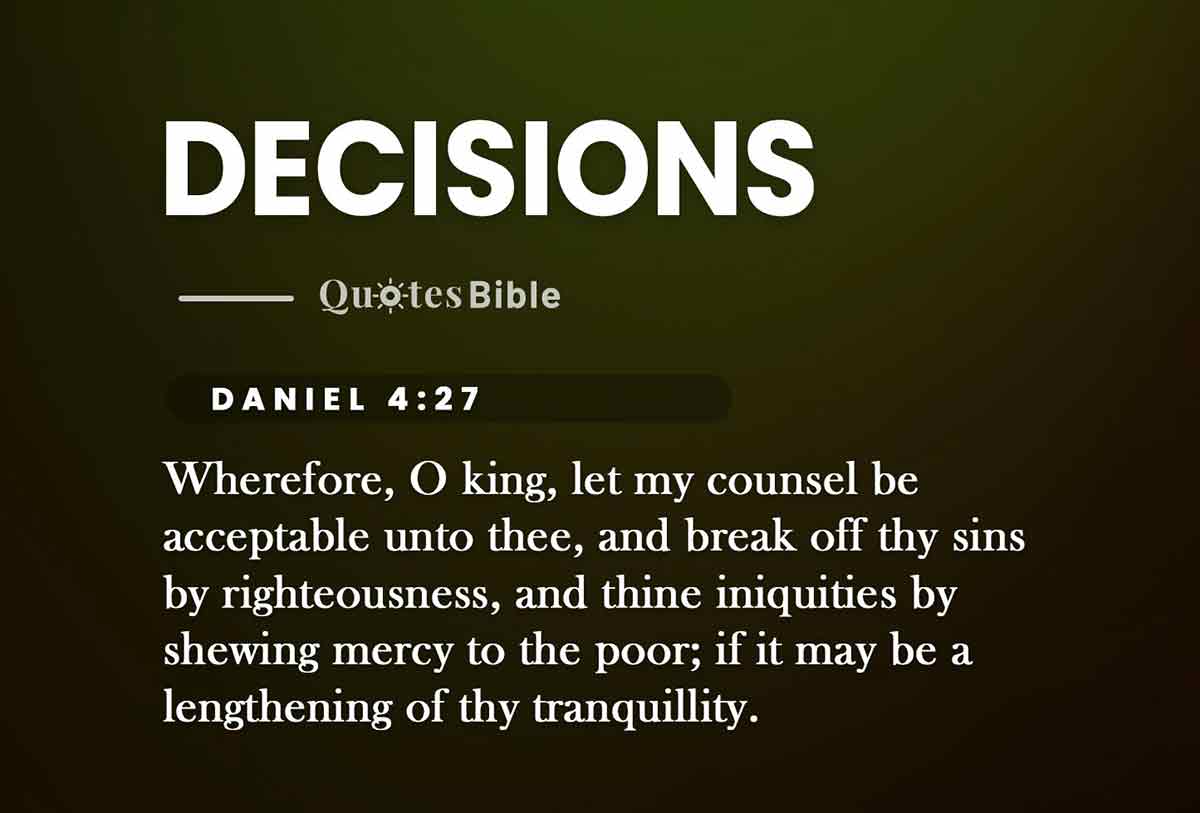
Life is often likened to a vast ocean, replete with myriad currents and capricious winds. Just as a mariner charts a course through both tempestuous storms and serene waters, so too do individuals navigate the labyrinthine paths of decision-making. The Bible serves as a compass, offering insights that guide believers through the tumult of choices, illuminating the perils and possibilities that lie before them.
At the heart of biblical wisdom is the profound understanding that choices not only shape one’s destiny but also reflect one’s character. Proverbs 3:5-6 implores us to “trust in the Lord with all your heart and lean not on your own understanding; in all your ways submit to him, and he will make your paths straight.” This metaphor of a straight path beckons the faithful to relinquish the illusion of self-sufficiency, suggesting instead that divine guidance can clear the fog of uncertainty, leading to wiser outcomes.
However, the process of decision-making is seldom a linear journey. It requires introspection, prayer, and sometimes, the counsel of others. Gathering wisdom is akin to collecting stars; every piece of advice and insight can serve as a guide in the night sky. In Proverbs 15:22, it states, “Plans fail for lack of counsel, but with many advisers, they succeed.” This highlights the importance of community in seeking clarity. Engaging with trusted friends, family, or mentors can illuminate perspectives that would otherwise remain obscured. By pooling collective wisdom, individuals can navigate challenges with greater acumen.
In moments of indecision, the Bible also advises patience. Ecclesiastes 3:1 reminds us, “There is a time for everything, and a season for every activity under the heavens.” This verse echoes the natural rhythms of life, suggesting that hasty decisions often lead to regret, much like planting seeds before the frost has passed. Waiting for the right time allows for reflection and ensures that decisions are not merely reactions but thoughtful responses to circumstances.
Moreover, the implications of choices extend beyond the individual. Each decision reverberates through the fabric of community, akin to a stone thrown into a tranquil pond, creating ripples that touch the lives of many. Galatians 6:7 warns, “Do not be deceived: God cannot be mocked. A man reaps what he sows.” This agricultural metaphor underscores the importance of considering the moral weight of our decisions; we must choose wisely to cultivate a harvest that honors both ourselves and others.
Decisions are often juxtaposed between the realms of the immediate and the eternal. Hebrews 11:1 articulates this beautifully: “Now faith is confidence in what we hope for and assurance about what we do not see.” In decision-making, faith serves as an anchor, grounding us in hope as we contemplate the unknown. This assurance allows individuals to take leaps of faith, trusting in the unseen while remaining committed to their values and aspirations.
Ultimately, making decisions informed by biblical principles requires a harmonious blend of discernment, humility, and courage. It calls for a heart willing to listen for that still, small voice amidst the chaos of life. By embracing a biblical framework, one is equipped not only to make personal choices but to influence the world positively. Every decision is a brushstroke on the canvas of existence, and guided by scripture, these strokes can create a masterpiece that reflects grace, wisdom, and love.
In conclusion, the art of decision-making, when intertwined with biblical wisdom, transcends mere practicality. It becomes a journey of faith, community, and moral integrity, inviting believers to participate in a divine narrative larger than themselves. As individuals navigate their choices, may they find solace and strength in the scripture, transforming ordinary decisions into extraordinary acts of devotion and purpose.

