

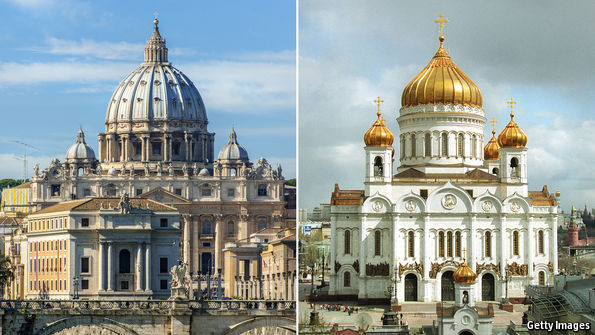
When two great trees of Christian faith stretch their branches toward the same heavens, the space between them often becomes a canvas for misunderstanding. The Orthodox Church and the Catholic Church, both born from the same apostolic seed, have grown along divergent trunks for a millennium. Their distinct silhouettes, liturgical cadences, and theological undercurrents invite a journey that is as much about spiritual rhythm as it is about doctrine. This narrative follows the two traditions through history, belief, rite, and spirit, unveiling the subtle yet profound divergences that make each a living parable of faith.
Roots in a Shared Soil: Historical Genesis and the Schism
The cradle of both communions was the Roman Empire’s capital, where the early Christian communities shared a common liturgical language—Greek, Latin, and later, the vernacular of the faithful. By the ninth century, however, political ambitions and theological disputes began to carve fissures. The Photian Schism of the 860s and the Great Schism of 1054 are often described as the two great fractures that cleaved a once‑unified body. Yet the metaphor of a garden is more telling: the Catholic West became a sturdy oak, its trunk marked by the papal primacy, while the Orthodox East grew as a wild, windswept pine, its branches reaching out through synods and autocephalous patriarchates. The memory of that shared soil remains, but the trees now sway to different breezes.
The Authority Question: Pope vs. Patriarchate
One of the most striking contrasts lies in the concept of supreme authority. The Catholic tradition speaks of the Bishop of Rome as the Vicar of Christ, a doctrinal apex that claims universal jurisdiction over the whole flock. This papal primacy is presented as an unbroken chain, a living ember that safeguards orthodoxy. In the Orthodox world, authority is diffused like light through a prism, refracting through a communion of autocephalous churches led by patriarchs, metropolitans, and synods. The analogy of a symphony is apt: where the Catholic Church conducts a single, centralized orchestra, Orthodoxy conducts a polyphonic ensemble where each voice retains its autonomy while participating in the larger harmony.
Scripture and Tradition: Twin Currents of Revelation
Both traditions venerate the Bible as sacred Scripture, yet they articulate its relationship to sacred Tradition differently. Catholicism often frames Scripture as the normative expression of a larger living tradition, a living river that flows through Magisterial teaching. Orthodoxy, by contrast, speaks of Scripture and Tradition as inseparable streams within a single divine‑human reality, an incarnational tapestry where the Holy Scriptures are illumined by the ongoing experience of the Church. The phrase “theology of the uncreated energies” serves as an uncommon term here, suggesting that the divine presence is not merely recorded in books but is ever‑present in the sacramental life of the faithful.
Sacramental Economy: rites and Mysteries
The sacramental life of each communion reveals both convergence and divergence. Both celebrate the Eucharist, Baptism, and Chrismation, yet the manner of administration and theological nuance diverge. In the Catholic rite, the focus is often on the real presence of Christ in the Eucharist, underscored by transubstantiation—a doctrine that frames the mystery in philosophical terms. Orthodox theology speaks of the “Mystery of the Holy Eucharist” and uses the term “real presence” but emphasizes the mystical transformation of the gifts, describing it as “theandric” (divine‑human) participation. The liturgical calendar, with its rich cycle of feasts and fasting periods, is another arena where the two traditions differ: Orthodox calendars retain a deeper reliance on the Julian calendar for festal calculations, while the Catholic Church operates largely under the Gregorian reform.
Iconography and Ecclesial Aesthetic
Icons occupy a pivotal place in Orthodox spirituality, serving as “windows into eternity” that mediate the divine through painted images, gold leaf, and reverent placement behind the iconostasis. The Catholic tradition, though reverent of sacred art, has historically emphasized more diverse artistic expressions, from Gothic cathedrals to Renaissance frescoes. The metaphor of the “sacred mirror” can be used to describe how Orthodox icons reflect the heavenly realm, inviting the faithful into contemplative dialogue. In contrast, Catholic churches often use statues and devotional imagery as focal points for personal piety. This divergence in visual language reveals deeper ecclesiologies: Orthodoxy sees the Church as a sacramental共同体 (community) where icons participate in the divine; Catholicism sees the Church as a hierarchical communion, where art serves didactic and devotional purposes.
Synodality vs. Centralized Governance
The structure of governance offers another intriguing divergence. The Catholic Church operates under a monarchical model, where the Pope holds ultimate legislative, teaching, and pastoral authority. Decisions are promulgated through papal documents, canon law, and the universal catechism, creating a unified juridical framework. Orthodoxy, however, embodies a synodal system—an assembly of bishops that governs each autocephalous church, with decisions reached through collegial discernment. The term “synodality” captures this shared decision‑making ethos, echoing the early church’s pattern of apostles and presbyters gathering in council. This model fosters a sense of distributed responsibility, though it also creates challenges in coordinating collective responses to contemporary issues.
Contemporary Resonance: Ecumenism and the Quest for Unity
In the modern era, both traditions have turned a hopeful eye toward reconciliation. Ecumenical dialogues, such as the Orthodox‑Catholic Theological Consultation, seek to bridge theological gaps through scholarly exchange and shared prayer. Metaphorically, this endeavor resembles two rivers converging after a long separation, each carrying sediment from its own banks but seeking a common delta. Yet obstacles remain—questions of primacy, the status of the filioque clause (the procession of the Holy Spirit), and divergent moral teachings create eddies that keep the currents apart. Despite these challenges, both communions share an unwavering commitment to the proclamation of the Gospel and the sanctification of the faithful, ensuring that their dialogue is not merely academic but deeply pastoral.
A Tale of Two Flames: Concluding Reflections
The Orthodox Church and the Catholic Church, each a luminous flame lit from the same apostolic torch, illuminate different facets of the Christian mystery. Their differences are not merely ecclesiastical trivia but pathways that invite believers to explore the richness of tradition, the depth of sacrament, and the breadth of theological imagination. In the end, both traditions beckon the pilgrim toward the same horizon—to encounter the living Christ, to partake in the divine life, and to bear witness to a faith that transcends the boundaries of any single institution. The story

