

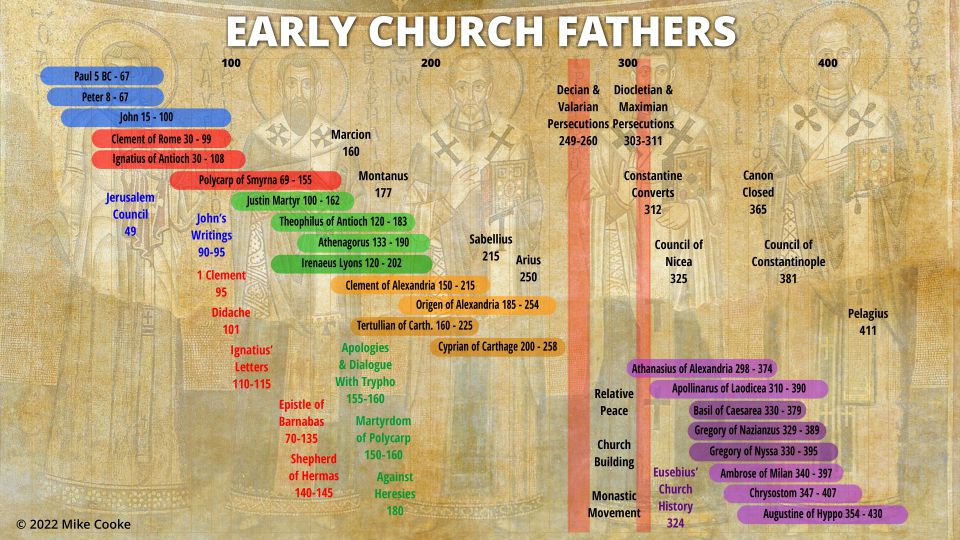
In the dawning centuries after the Pentecost, a chorus of charismatic teachers emerged from the Roman Empire’s sprawling cities, their voices echoing across basilicas, catacombs, and desert cells. These luminaries are collectively known as the Early Church Fathers—a cadre of theologians, apologists, and bishops whose writings laid the cornerstone of Christian doctrine and practice. Their narratives, forged in the crucible of persecution and philosophical debate, still reverberate in contemporary worship, ethics, and theological scholarship. This exploration invites readers to traverse the ancient corridors of patristic thought, uncovering the identities of these seminal figures, their doctrinal innovations, and the enduring relevance they hold for modern believers.
The Patristic Mosaic: Defining the Early Church Fathers
The term “Patristic” originates from the Latin pater, meaning “father,” and refers to the influential Christian writers of the first eight centuries. They were not a monolithic group; rather, they formed a mosaic of diverse locales, theological emphases, and liturgical customs. From the apostolic fathers who walked alongside the original disciples to the great Cappadocian theologians of the fourth century, each contributed a distinct thread to the emerging tapestry of orthodoxy. Their writings—ranging from epistolary treatises to verbose commentaries—were instrumental in shaping the canon of Scripture, the formulation of creeds, and the articulation of Christological and pneumatological doctrines. Understanding this definition is crucial for appreciating how a constellation of voices collectively forged a unified faith narrative.
Beyond mere chronology, the fathers embodied a passionate pursuit of truth, often confronting heresy with rigorous argumentation and pastoral care. Their legacy is not confined to academic circles; it permeates the liturgical language used in today’s hymns, the doctrinal statements recited in catechisms, and the ethical sensibilities that guide countless congregations.
A Gallery of Giants: Principal Figures and Their Contributions
Among the earliest luminaries, Ignatius of Antioch stands out for his letters urging believers to remain steadfast within the “catholic” Church, a term he employed to denote universal orthodoxy. Clement of Rome’s epistle to the Corinthians illustrates the nascent hierarchy and the early practice of apostolic succession. Moving forward, Origen’s speculative exegesis laid groundwork for allegorical interpretation, while Tertullian’s rigorous defense of the Trinity introduced Latin theological vocabulary that persists to this day. The Nicene era brought forth the Cappadocian trio—Basil the Great, Gregory of Nyssa, and Gregory of Nazianzus—whose synthesis of Greek philosophy and biblical revelation clarified the doctrines of the Holy Spirit and the hypostatic union of Christ. Augustine of Hippo, perhaps the most towering figure, authored Confessions and The City of God, reshaping Western theology with notions of grace, predestination, and original sin.
These fathers were not isolated scholars; they were bishops, monks, and evangelists whose lives intersected with imperial politics, persecutions, and cultural shifts. Their personal anecdotes—Ignatius’s martyrdom on the Roman arena, Athanasius’s exile, and John Chrysostom’s fiery homilies—imbue their writings with an immediacy that continues to stir the hearts of readers.
Doctrinal Architecture: Theological Contributions and Creeds
The Early Church Fathers served as architects of doctrinal precision. Through councils such as Nicaea (325) and Constantinople (381), they hammered out the foundational creeds that defined the nature of God—Father, Son, and Holy Spirit—as co-eternal and consubstantial. The Nicene Creed, largely shaped by Athanasius and later refined by the Cappadocians, became a rallying point against Arianism and other heterodox views. Patristic exegesis also clarified soteriology: the doctrine of salvation through Christ’s incarnation, death, resurrection, and ascension. Irenaeus of Lyon advanced the concept of “recapitulation,” wherein Christ’s obedience restored humanity’s broken relationship with the divine. This theological scaffolding still undergirds contemporary confessions and ecumenical dialogues.
In addition, the fathers forged a robust understanding of the Church as the mystical Body of Christ. Cyprian of Carthage emphasized the necessity of unity and the validity of sacraments administered within the canonical community, a notion that continues to inform ecclesiology.

