

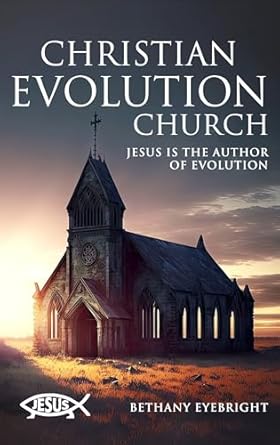
Within the hallowed walls of the church, an ancient narrative mingles with the quiet hum of scientific discovery. The biblical story of creation, once read as a static tableau, now reverberates through the corridors of evolutionary biology, inviting believers to see the hand of God not only in the first “let there be” but also in the continual unfolding of life. This article explores how the church can engage the theory of evolution through a biblical lens, weaving theological doctrine, scripture, and contemporary thought into a seamless tapestry of faith and inquiry.
The Imago Dei as a Living Canvas
Scripture declares that humanity is created in the image of God, a phrase that has traditionally been understood as a fixed, immutable likeness. Yet the Bible also speaks of God “breathing” life into dust, a dynamic infusion that suggests an ongoing creative act. Evolution, with its gradual unfolding of species, can be interpreted as the divine breath continuously shaping that image over eons. In this view, the imago Dei is not a static portrait but a living canvas, each brushstroke of natural selection adding nuance to the divine portrait. The theological concept of “pneumatic imprint” thus becomes a metaphor for the continual indwelling of the Holy Spirit within the evolving biosphere.
Genesis Reimagined: Cosmic Architecture and Biological Genesis
The opening chapters of Genesis are often read as a chronological timeline, but literary analysis reveals a poetic, liturgical structure designed to convey theological truths rather than scientific details. The six “days” of creation mirror the ancient Near Eastern seven‑day week, a rhythm that invites Sabbath reflection. When we view Genesis as a cosmic architecture—blueprints laid out by an omniscient architect—evolutionary processes become the construction methods through which the Divine Builder implements His design. Metaphors of “foundations,” “pillars,” and “domes” help the faithful visualize how natural mechanisms can serve as the scaffolding for divine intention.
Theistic Evolution: A Bridge Between Pulpit and Laboratory
Theistic evolution posits that God directs the evolutionary process without intervening in every mutation. This perspective draws heavily on the doctrine of providence, arguing that the same divine agency that sustains the cosmos also orchestrates genetic variation. The concept of “uncaused causation” is central here: God, as the primary cause, employs secondary causes like natural selection as instruments. By framing evolutionary biology as a subset of divine governance, the church can foster dialogue between theologians and scientists, creating a “bio‑hermeneutic” that respects both empirical evidence and scriptural authority.
Historical Echoes: Early Church Fathers and Medieval Thought
Early church fathers such as Augustine contemplated the nature of creation, suggesting that God’s power works through “secondary causes,” a notion that prefigures modern scientific explanation. In the medieval era, Thomas Aquinas调和了信仰与理性,提出宇宙是一个有序的整体,其中的每一步变化都体现了神圣的智慧. 这些历史回声表明,教会并非必然排斥科学进步,而是常常在神学的框架内吸收新的认知.
Modern Theological Currents: Progressive Creation and Darwinian Dialogues
Contemporary theologians like “BioLogos” advocate for a progressive creation model, emphasizing that the universe’s developmental narrative is itself a revelation. This approach aligns with the idea of “ontological mosaic,” wherein discrete biological events are woven into a larger spiritual quilt. Meanwhile, more conservative circles maintain a literal six‑day creation, creating a spectrum of beliefs. The challenge for the modern church lies in navigating this spectrum while preserving communal unity. Emphasizing the shared goals of honoring God and loving neighbor can bridge differing interpretive camps.
Metaphorical Liturgy: The Cathedral of Life
Imagine the entire biosphere as a grand cathedral, its arches formed by geological strata, its stained‑glass windows painted by pigments of DNA, and its choir comprising the myriad species that sing the song of existence. In this metaphorical liturgy, evolution is the ongoing construction of the nave, where each generation adds a new stone to the structure. The church, as a living community, enters this cathedral to worship, recognizing that the divine architect continually renews the edifice. This imagery invites believers to see the world not as a static exhibit but as a vibrant sanctuary awaiting further revelation.
Practical Ecclesiology: Nurturing Faith in a Scientific Age
To nurture faith amid scientific literacy, churches can incorporate educational programs that explore the intersections of theology and biology. Workshops on hermeneutical flexibility, guided discussions on the nature of biblical inspiration, and collaborative events with local universities can demystify evolution for congregants. Pastoral counseling that acknowledges the emotional weight of perceived conflicts and offers spiritual reassurance is essential. By cultivating a “theological curiosity,” the church transforms potential tension into a catalyst for deeper spiritual reflection.
Conclusion: An Ever‑Expanding Sacred Narrative
The biblical perspective on evolution invites the church to view creation as an ever‑expanding narrative, where divine authorship remains intact while the plot thickens through natural processes. The metaphors of image, breath, architecture, and cathedral provide a rich tapestry for understanding humanity’s place in the cosmos. As the faithful engage these ideas, they partake in a living

