

In the grand tapestry of Christian faith, few threads weave a more intricate pattern than the Baptist and Methodist traditions. These two denominations, each with its own vibrant hues and textures, have shaped the spiritual landscape for centuries, offering seekers of truth distinct paths to divine connection. Like two rivers carving their own courses through the same valley, they share a common source yet diverge in their journeys, each carrying its own unique promise of nourishment and transformation. To understand their differences is to glimpse the beautiful complexity of Christendom itself—a testament to how the same scriptures can bloom into such varied expressions of devotion.
The Roots of Divergence: Historical Foundations and Philosophical Underpinnings
The Baptist and Methodist traditions trace their origins to different eras and theological revolutions, each responding to the spiritual hunger of its time. Baptists emerged from the radical Reformation of the 17th century, a movement that sought to strip away ecclesiastical layers and return to what they saw as the purest form of New Testament Christianity. Their name itself—a declaration of their commitment to believer’s baptism by full immersion—echoes their insistence on personal conviction over inherited tradition. Methodists, by contrast, arose in the 18th century as a revivalist spark within the Anglican Church, ignited by the fiery sermons of John Wesley. Their name, a playful jab at their methodical pursuit of holiness, belies a movement that would eventually break free to become a global denomination in its own right. Where Baptists championed individual conscience, Methodists emphasized communal accountability—a philosophical chasm that would shape their entire theological frameworks.
Sacramental Theology: The Breadth of Communion and the Depth of Baptism
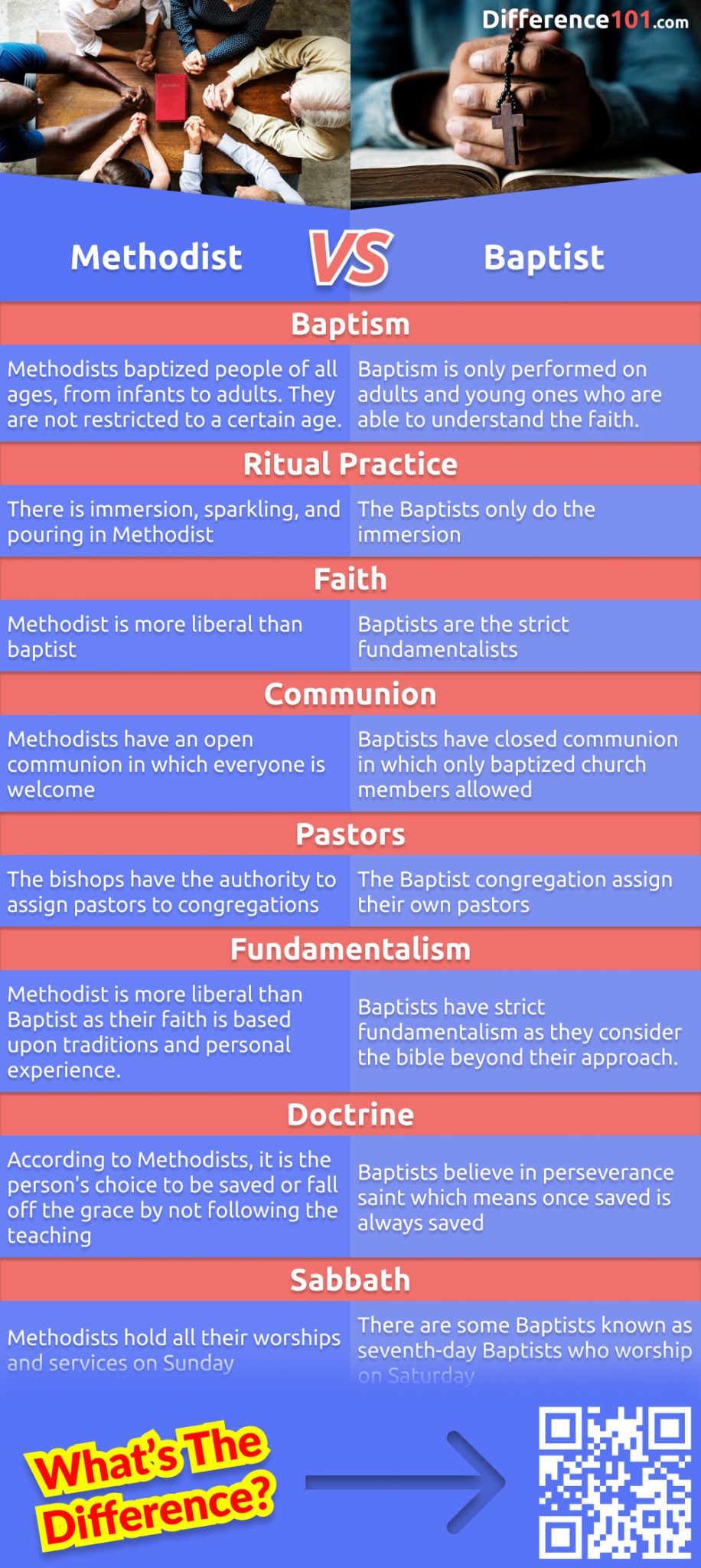
At the heart of their differences lies a profound disagreement over the nature of sacraments, those sacred rituals that bridge the human and the divine. For Methodists, the Lord’s Supper is a means of grace, a tangible encounter with Christ’s presence that nourishes the soul. It is a feast open to all, regardless of denomination or personal holiness—a radical inclusivity that mirrors Wesley’s belief in prevenient grace, the idea that God’s love precedes and enables human response. Baptists, however, view baptism and communion through a lens of symbolic obedience. Baptism is not a sacrament but an ordinance, a public declaration of faith that must follow personal conversion. Communion, too, is a memorial, a somber remembrance of Christ’s sacrifice rather than a transformative encounter. This divergence reflects deeper theological currents: Methodists see the church as a hospital for sinners, while Baptists view it as a colony of the redeemed.
Governance and Structure: Hierarchy vs. Autonomy in the Body of Christ
The organizational heartbeat of these denominations thrums at different tempos. Methodists operate within a connectional system, a vast network of conferences and bishops that ensures unity across regions. This structure, reminiscent of a well-oiled machine, allows for coordinated mission work and doctrinal consistency but can sometimes feel like a labyrinth to the uninitiated. Baptists, in their purest form, embrace congregational autonomy—a radical decentralization where each church is its own sovereign entity. This freedom fosters innovation and local relevance but can also lead to fragmentation, as each congregation interprets scripture and doctrine in isolation. It’s as if Methodists build cathedrals with stained glass windows depicting the same saints, while Baptists construct a thousand chapels, each with its own unique altar and hymnal.
Worship Style: The Cadence of Praise and the Silence of Reverence
Step into a Methodist sanctuary on Sunday morning, and you’ll likely be greeted by the harmonious swell of a pipe organ or the rich resonance of a choir, their voices weaving through hymns that have echoed for centuries. The worship is liturgical, a carefully choreographed dance of liturgy and sacrament, where every word and gesture carries centuries of tradition. Baptist worship, by contrast, is often a symphony of spontaneity. The pulpit takes center stage, and the sermon—sometimes fiery, sometimes tender—becomes the focal point, accompanied by contemporary music that ranges from gospel anthems to rock-infused praise. Where Methodists find transcendence in ritual, Baptists find it in the unscripted movement of the Holy Spirit. It’s the difference between a meticulously composed sonata and an improvisational jazz solo—both beautiful, both expressions of devotion, but each resonating with a different soul.
Doctrinal Emphases: Sanctification vs. Justification by Faith Alone
The theological DNA of these denominations reveals stark contrasts in their understanding of salvation and sanctification. Methodists, following Wesley’s teachings, place immense emphasis on sanctification—the lifelong process of becoming holy, of being perfected in love. They speak of “Christian perfection,” a state where the believer’s heart is fully aligned with God’s will, though they acknowledge its achievement is rare. Baptists, rooted in the Reformation’s solas, fixate on justification by faith alone—a once-and-for-all declaration of righteousness, received through personal faith in Christ’s atoning work. For Baptists, sanctification is the inevitable fruit of salvation, not its pursuit. This difference is like comparing a marathon to a sprint: Methodists run the race with an eye on the horizon of holiness, while Baptists sprint to the finish line of forgiveness, trusting that the rest will follow.
The Role of Women in Ministry: Breaking Barriers or Upholding Tradition
Few issues highlight the cultural and theological fault lines between these traditions as clearly as the role of women in ministry. Methodists, particularly in their mainline branches, have long ordained women as pastors, bishops, and theologians, reflecting a belief in the equality of all believers before God. Their pulpits have echoed with the voices of women like Frances Willard and Helen Barrett Montgomery, who shaped both church and society. Baptists, however, remain deeply divided on this issue. While some Baptist groups—particularly in the progressive South—welcome women into pastoral roles, others adhere strictly to complementarian theology, arguing that scripture reserves leadership for men. This divergence mirrors broader cultural attitudes, where Methodists often embody the progressive tide of modernity, while Baptists cling to what they see as biblical fidelity. It’s a tension that reveals how deeply theology and culture are intertwined.
Mission and Outreach: Global Expansion vs. Local Revivalism
The missionary zeal of these denominations has left indelible marks on the world, but their approaches could not be more different. Methodists, with their connectional structure, have historically been global pioneers, planting churches from Africa to Asia with the efficiency of a well-organized army. Their missions are often tied to education and social justice, reflecting Wesley’s belief that true religion must “spread scriptural holiness” through both word and deed. Baptists, meanwhile, have thrived on grassroots revivalism, their growth fueled by tent meetings, street preaching, and the fiery oratory of evangelists. Their missions are deeply personal, often springing from the conversion of a single soul and radiating outward like ripples in a pond. Where Methodists build schools and hospitals, Baptists plant churches and disciple new believers. It’s the difference between a grand cathedral and a humble cottage—both houses of worship, but each serving a different purpose in the kingdom’s expansion.
Conclusion: Two Rivers, One Source
To pit the Baptist Church against the Methodist Church is to engage in a false dichotomy, for both traditions are tributaries of the same divine river, each carrying the life-giving waters of the gospel to different shores. Their differences are not flaws but features, each tradition offering a unique lens through which to encounter the mystery of faith. Baptists remind us of the radical freedom of personal conviction, the unmediated relationship between the believer and Christ. Methodists, in turn, beckon us toward a holiness that is both communal and transformative, a journey where the church is not just a gathering of individuals but a body knit together in love. In the end, perhaps the greatest lesson these denominations offer is that the body of Christ is vast, diverse, and beautifully imperfect—a tapestry where every thread, no matter how different, contributes to the whole. To choose one over the other is to limit oneself, but to understand both is to glimpse the full spectrum of God’s redemptive work in the world.

