

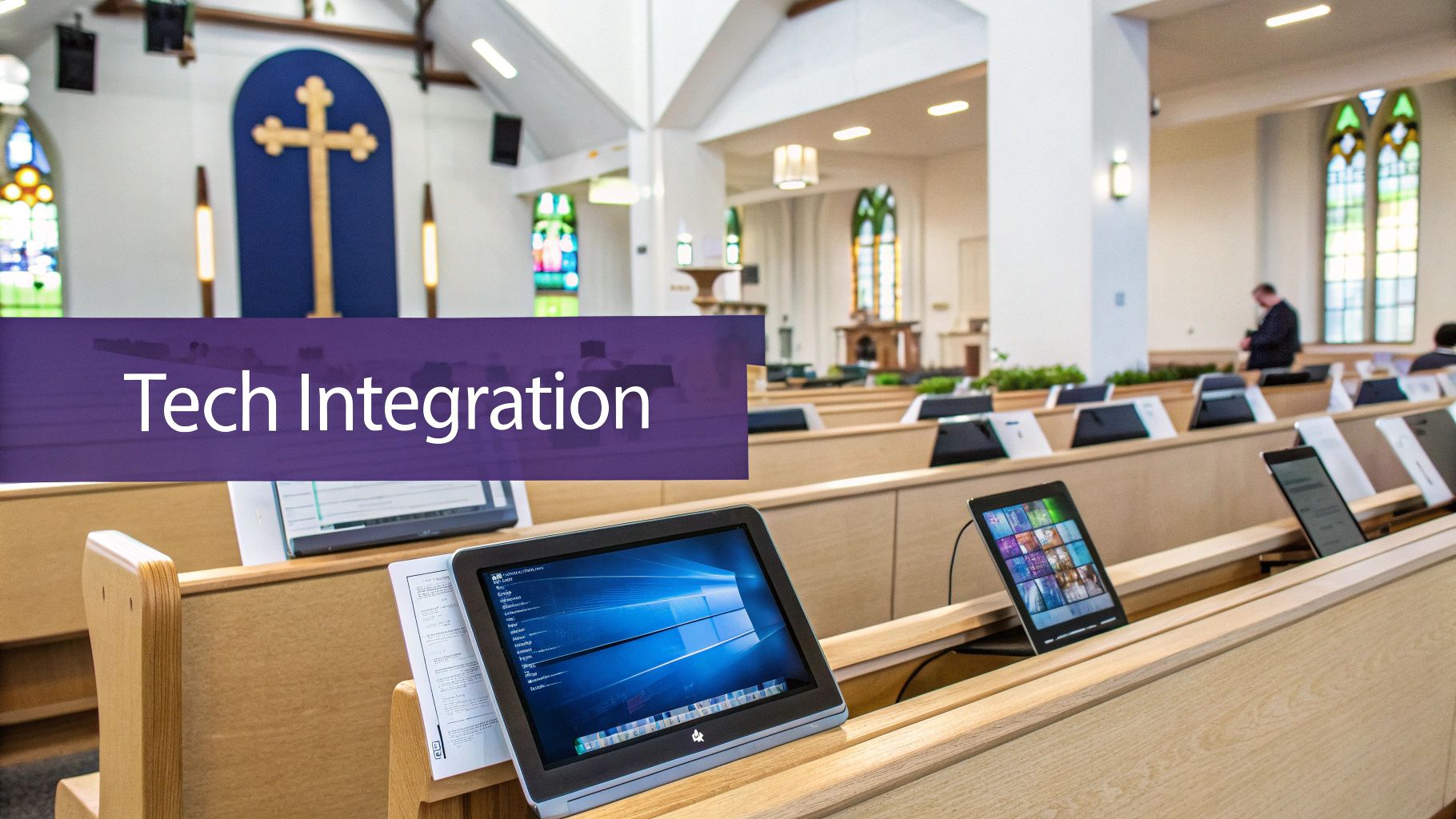
In an era where a single swipe can summon a sermon, where a congregation gathers not just in pews but in pixels, and where silence is broken not by organ chords but by the gentle hum of servers, the modern church stands at a crossroads of tradition and transformation. The digital age has not merely knocked on the door of the sacred—it has walked in, sat down, and begun rearranging the furniture. Yet beneath the glow of screens and the rhythm of keystrokes lies a deeper question: Is technology reshaping the church, or is the church reshaping technology to serve its eternal mission?
The Digital Pulpit: Preaching Beyond the Sanctuary Walls
Gone are the days when a sermon was confined to Sunday morning, echoing through stained glass and wooden pews. Today, the digital pulpit stretches across continents, transcending time zones and linguistic barriers. Livestreamed services allow a single message to reach thousands—millions, even—simultaneously. A pastor in Nairobi can preach to a congregation in Nairobi, New York, and Nairobi, Texas, all at once. The sermon, once a local event, has become a global phenomenon, its resonance amplified by algorithms that curate content based on curiosity rather than geography.
But this expansion is not without consequence. The intimacy of a shared physical space, where breath mingles with breath and tears fall on the same wooden floor, cannot be fully replicated in a 1080p feed. The digital pulpit offers reach, but it demands intentionality. Churches must now ask: How do we maintain the sacredness of the message when it flickers on a smartphone screen? How do we ensure that the warmth of a handshake is not replaced by the cold distance of a “like” button? The answer lies not in rejecting technology, but in mastering its rhythm—using it to extend the sanctuary, not to erase it.
Community in the Cloud: The Parish Without Walls
The church has always been a community, a tapestry of shared stories, struggles, and celebrations. But what happens when that tapestry is woven not in fellowship halls, but in Facebook groups, Discord servers, and Zoom breakout rooms? The digital parish is a paradox: it is both vast and intimate, a crowd where every individual can be seen. Small groups that once met in living rooms now convene in virtual sanctuaries, their faces illuminated by the soft glow of laptop screens. Prayer requests are typed into chat boxes. Bible studies unfold in real-time, with participants from Tokyo to Toronto chiming in with insights.
Yet the challenge is profound. How do we cultivate belonging when the only shared space is a digital one? How do we prevent the parish from becoming a collection of avatars rather than souls? The key lies in intentional design. Churches must move beyond broadcasting and into dialogue. They must create spaces where silence is not awkward, where laughter is not lost in lag, and where the Eucharist—when shared virtually—is not diminished but reimagined. The cloud can be a sanctuary, but only if we treat it as such.
The Algorithm of Grace: When Technology Meets Theology
Algorithms are the unseen priests of the digital age, shaping what we see, hear, and believe. They decide which posts rise to the top, which voices are amplified, and which truths are buried beneath the noise. For the church, this presents a theological dilemma: Can grace be algorithmic? Can the Holy Spirit be optimized? The answer is both yes and no. Yes, because technology can help us reach those who might never step into a church. No, because grace cannot be reduced to engagement metrics or click-through rates.
Consider the power of targeted outreach. A church in a secular city can use data to identify neighborhoods where faith is fading and tailor its message accordingly. Social media ads can introduce seekers to sermons, podcasts, or even virtual prayer partners. But here lies the tension: When outreach becomes optimization, does it risk commodifying the gospel? The danger is real—turning salvation into a subscription service, discipleship into a marketing campaign. The church must use technology as a tool, not a crutch. It must remember that the algorithm can point to the door, but it cannot open it.
Security in the Sanctuary: Protecting the Flock in a Digital Age
With great connectivity comes great vulnerability. The same tools that unite the church can also expose it. Data breaches, online harassment, and the misuse of personal information are not hypothetical risks—they are realities. A church’s digital footprint must be as secure as its physical one. Passwords must be stronger than hymns. Firewalls must be as vigilant as elders. And just as the church guards its people from physical harm, it must now guard their digital lives from predators, scammers, and trolls.
But security is not just about protection—it’s about trust. Congregants must feel safe sharing their stories, their struggles, and their donations online. They must know that their data is not a commodity to be sold, but a sacred trust to be honored. This requires transparency, robust cybersecurity practices, and a commitment to ethical data use. The church must lead by example, showing the world that even in the digital wilderness, holiness can be a guiding light.
The Future of Worship: From Pixels to Presence
The ultimate question is not whether the church should embrace technology, but how it should do so without losing its soul. The future of worship may lie in augmented reality, where congregants can “attend” a service in a virtual Jerusalem, or in blockchain-based systems that ensure the integrity of charitable giving. It may lie in AI-powered chatbots that offer pastoral care or in holographic preachers that bridge the gap between past and present.
Yet for all its innovation, the church must never forget its essence: it is not a platform, but a people. It is not a code, but a covenant. Technology can enhance worship, but it cannot replace it. It can connect, but it cannot commune. The goal is not to digitize the divine, but to humanize the digital—to ensure that every screen, every app, every line of code serves a greater purpose: to draw people closer to the One who transcends all technology.
In the end, the church’s relationship with technology is not a surrender, but a dialogue. It is a conversation between the ancient and the avant-garde, between the timeless and the timely. And like all great conversations, it requires listening as much as speaking, patience as much as progress, and above all, a deep reverence for the mystery that no algorithm can ever fully capture.

