

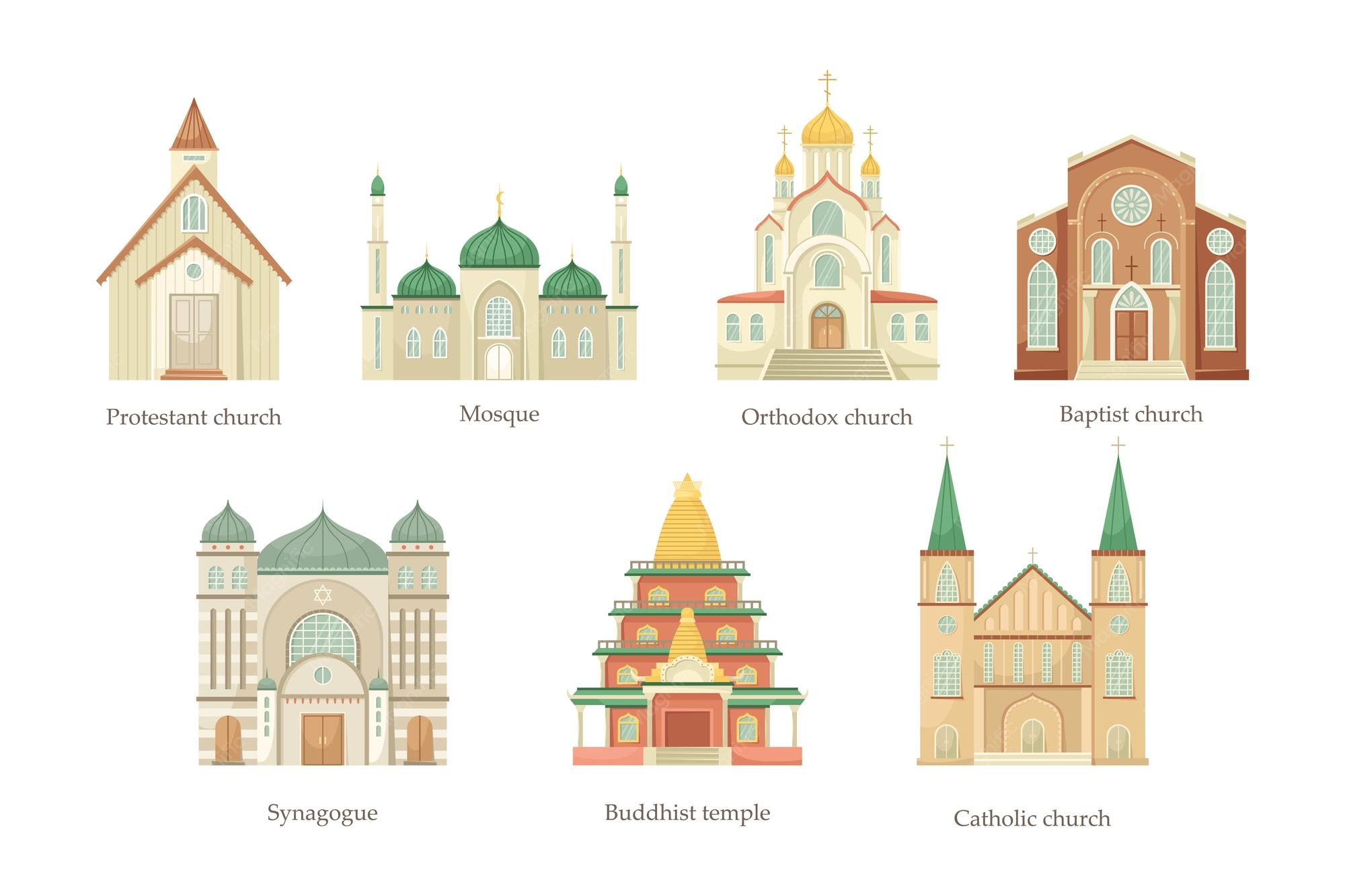
There’s something quietly profound about standing before a church—its spires piercing the sky, its stained glass casting kaleidoscopic hues across ancient stones. These structures aren’t merely buildings; they are living testaments to human devotion, architectural ingenuity, and cultural identity. Yet, what often escapes casual observation is the staggering diversity in their forms. From the soaring Gothic cathedrals that seem to defy gravity to the humble wooden chapels nestled in remote valleys, each church tells a story not just of faith, but of history, geography, and the unyielding human spirit. Why do these differences exist? What deeper currents shape them? To understand churches is to unravel the threads of human aspiration, tradition, and the eternal quest for transcendence.
The Gothic Grandeur: Cathedrals That Reach for Heaven
Gothic cathedrals are the titans of ecclesiastical architecture, their ribbed vaults and flying buttresses a symphony of structural daring. Born in 12th-century France, these marvels—like Notre-Dame or Cologne Cathedral—were designed to evoke awe, their towering spires seemingly plucked from the heavens. The Gothic style wasn’t just about aesthetics; it was a theological statement. The pointed arches directed worshippers’ gaze upward, symbolizing humanity’s yearning for the divine. Light, too, played a sacred role. Stained glass windows, intricate and luminous, transformed sunlight into a celestial tapestry, illustrating biblical narratives in a language of color and refraction. These cathedrals weren’t built by hands alone; they were forged in the crucible of medieval faith, where every stone was laid with the conviction that the earthly could mirror the heavenly.
The Byzantine Brilliance: Domes That Cradle the Divine
If Gothic cathedrals ascend, Byzantine churches descend—into the earth, as it were—through their iconic domes. Originating in the Eastern Roman Empire, structures like Istanbul’s Hagia Sophia or Ravenna’s Basilica of San Vitale redefine sacred space with their domed ceilings, which seem to float weightlessly above the congregation. This architectural innovation wasn’t merely structural; it was theological. The dome symbolized the vault of heaven, with Christ Pantocrator (the “Ruler of All”) often depicted at its apex, gazing down upon the faithful. The interplay of light and mosaic—gold leaf shimmering against azure backdrops—created an otherworldly ambiance, as if the church itself were a portal to the celestial. Here, architecture becomes theology in stone and glass, where every curve and corner whispers of eternity.
The Romanesque Ruggedness: Fortresses of Faith
Before the Gothic revolution, there was the Romanesque—sturdy, unyielding, and unapologetically earthbound. Churches like Durham Cathedral or the Abbey of Cluny in France are characterized by their thick walls, rounded arches, and small, narrow windows, evoking the fortified castles of medieval Europe. This wasn’t accidental. The Romanesque era (roughly 9th to 12th centuries) was one of upheaval—Viking raids, political instability—so these churches doubled as sanctuaries, their heavy masonry offering both spiritual and physical refuge. The interiors, often dimly lit, were designed to evoke a sense of mystery, with frescoes and carvings narrating sacred stories in a language of shadow and light. These structures remind us that faith, too, can be a bulwark against chaos, a steadfast anchor in turbulent times.
The Baroque Exuberance: A Feast for the Senses
Enter the Baroque period, and churches become theatrical stages where every element—from gilded altarpieces to undulating facades—demands to be seen, heard, and felt. Churches like Rome’s Il Gesù or Vienna’s Karlskirche are veritable explosions of ornamentation, their interiors a riot of marble, stucco, and frescoes that blur the line between art and devotion. This wasn’t mere indulgence; it was a calculated response to the Counter-Reformation. The Catholic Church, facing the rise of Protestantism, sought to dazzle the senses, to overwhelm the faithful with the grandeur of divine truth. The result? A style that is unapologetically extravagant, where every curve and flourish seems to dance with the divine. Baroque churches don’t just house worship; they stage it, turning the act of prayer into a sensory spectacle.
The Minimalist Sanctuaries: Silence as Sacred Space
Yet, not all churches shout their devotion. In stark contrast to the Baroque’s exuberance, modernist and minimalist churches—like Le Corbusier’s Notre-Dame-du-Haut in Ronchamp or Tadao Ando’s Church of the Light in Japan—embrace silence as their most potent tool. These structures strip away ornamentation, leaving raw concrete, unadorned wood, and the play of natural light to evoke the sacred. The effect is profound. In a world saturated with noise, these churches offer a space of quiet reflection, where the absence of distraction becomes the presence of the divine. It’s a reminder that sometimes, the most powerful architecture is the one that doesn’t speak at all—it simply *is*, a vessel for the ineffable.
The Vernacular Chapels: Faith in the Everyday
Not all churches are grand cathedrals or avant-garde masterpieces. Many are humble, born of local tradition and necessity. Think of the whitewashed chapels of the Greek islands, their blue domes mirroring the Aegean Sea, or the timber-framed churches of Scandinavia, their log walls whispering of Viking lore. These structures are the antithesis of monumental architecture; they are intimate, organic, and deeply rooted in their surroundings. Built from materials at hand—stone, wood, thatch—they reflect the ingenuity of communities that saw no need for the extravagant. Yet, in their simplicity lies a profound truth: the sacred isn’t confined to the monumental. It thrives in the everyday, in the quiet corners where generations have gathered to pray, to mourn, and to hope.
The Modern Metamorphosis: Churches in the 21st Century
Today, churches are evolving in ways that challenge centuries of tradition. Some, like the striking glass-and-steel structures of contemporary megachurches, embrace transparency and accessibility, their open designs inviting the outside world in. Others, like the underground chapels of subterranean cities or the repurposed industrial spaces turned into worship centers, reflect a world where sacred and secular spaces increasingly blur. Even the materials have changed—carbon fiber, recycled steel, and 3D-printed concrete are finding their way into ecclesiastical architecture. Yet, for all their innovation, these modern churches grapple with the same questions as their ancient counterparts: How do we make the divine tangible? How do we create spaces that nurture the soul in an age of distraction? The answers may differ, but the quest remains eternal.
Why Do These Differences Fascinate Us?
The diversity of church architecture isn’t just a historical curiosity—it’s a mirror held up to humanity itself. Each style, each era, each region reveals something profound about the people who built them. The Gothic cathedrals speak of a time when faith and fear coexisted, when humanity dared to reach for the heavens. The Byzantine domes whisper of empires that saw themselves as divine extensions on earth. The Romanesque fortresses tell of communities clinging to hope amid chaos. The Baroque churches reveal a Church that understood the power of spectacle. The minimalist sanctuaries remind us that sometimes, less is more. And the vernacular chapels? They teach us that the sacred isn’t found only in the grand, but in the quiet, the local, the deeply personal.
Perhaps what fascinates us most is the realization that these buildings are more than stone and glass. They are the physical manifestations of our collective dreams, fears, and aspirations. They are the places where heaven and earth seem to touch, where the temporal and the eternal intersect. And in a world that often feels fragmented, they offer a glimpse of unity—not in uniformity, but in the shared human desire to create, to worship, and to transcend.

