

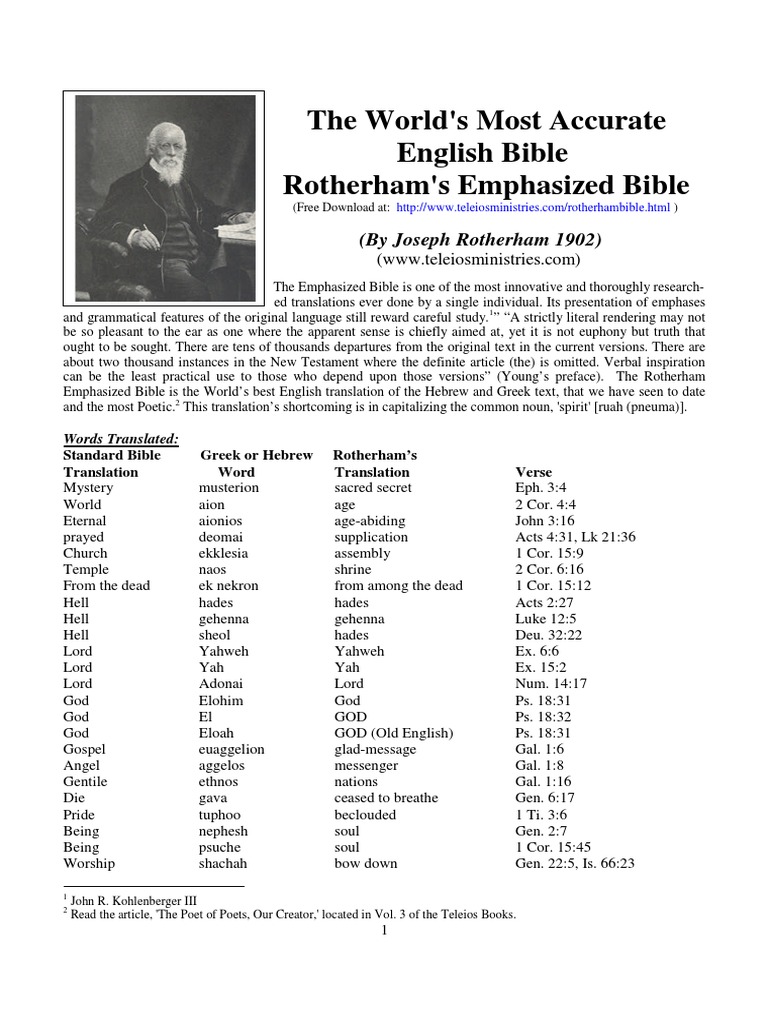
In the annals of theological discourse, the question of which Bible version stands as the most accurate has ignited fervent discussions among scholars, clergy, and lay readers alike. This inquiry, seemingly straightforward, unravels into a complex tapestry woven with layers of linguistic nuance, historical context, and doctrinal significance. At the heart of this exploration lies an engaging paradox: the quest for a definitive version is as multifaceted as the text itself. Herein, we will traverse the terrain of biblical accuracy, examine influential translations, and ultimately uncover the implications of language on spiritual understanding.
To embark on this journey, one must first grapple with what is meant by “accuracy.” Generally speaking, accuracy in biblical texts can be bifurcated into two primary categories: formal equivalence and dynamic equivalence. Formal equivalence favors a word-for-word translation philosophy, striving to preserve the original language’s syntax and lexicon. By contrast, dynamic equivalence adopts a thought-for-thought approach, aiming to convey the intended meaning and essence rather than the literal words. Each methodology carries its own merits and pitfalls, shaping how contemporary readers engage with ancient scripture.
The King James Version (KJV), a quintessential example of formal equivalence, looms large in the realm of English translations. Commissioned in the early 17th century, the KJV has garnered esteem for its poetic cadence and literary richness. However, its accuracy can be debated on account of the limited manuscript evidence available at the time of its translation. Moreover, linguistic evolution has rendered some of its language archaic, posing potential barriers for modern readers. Thus, while the KJV remains a cultural and religious touchstone, it may not encapsulate the most accurate rendition of biblical scripture in light of current scholarly understanding.
Contrasting sharply with the KJV is the New International Version (NIV), renowned for its dynamic approach. This translation prioritizes readability while endeavoring to remain faithful to the original texts. By employing contemporary vernacular, the NIV appeals to a broad audience, making the scriptures accessible to those unacquainted with ecclesiastical jargon. Yet, critics posit that in its quest for clarity, the NIV sometimes sacrifices the subtlety inherent in the original languages. Thus, the debate rages on: does the salience of accessibility inherently undermine the fidelity to the original meaning? This dichotomy beckons readers to question their own interpretive frameworks.
As we delve deeper into the realm of translations, we encounter the English Standard Version (ESV). This translation has emerged as a favorite among many evangelical communities, valued for its balance between formal and dynamic equivalence. The ESV aspires to retain the literary elegance of scripture while enhancing clear comprehension. Advocates laud its accuracy, citing its alignment with the most reliable manuscript traditions available today. However, the ESV’s dense language still poses challenges for some, inviting us to ponder: is it possible to achieve both reverence for the original text and accessibility for the modern reader?
Another prominent contender is the New Revised Standard Version (NRSV), often lauded for its inclusivity and scholarly rigor. Renowned for its ecumenical approach, the NRSV strives to represent a diverse readership more accurately. Yet, the pursuit of inclusiveness raises critical questions about linguistic choices that reflect contemporary societal values. In what ways do these choices reshape our understanding of scripture? And to what extent can a translated text encapsulate the original cultural context without imposing modern sensibilities?
The arrival of the Modern English Version (MEV) further complicates the landscape. Positioned as an update to the KJV, the MEV attempts to maintain the stylistic integrity of its predecessor while making it more comprehensible through contemporary language. Its aim is notable: to bridge the gap between traditionalist preferences and modern linguistic sensibilities. However, critics argue that any adaptation carries the risk of diluting theological richness, sparking discourse on the balance between tradition and transformation.
As readers grapple with these versions, an essential aspect emerges—the influence of cultural contexts on interpretation. Each Bible version not only reflects linguistic choices but also embodies the theological perspectives of its translators. This phenomenon invites the faithful to ponder how interpretations may vary based on differing doctrinal commitments. The historical backdrop of each translation reflects socio-political climates, creating a dynamic interplay between text and context.
What emerges from this discourse is not merely a quest for the “most accurate” translation but rather a deeper understanding of the motivations behind these choices. The multiplicity of versions serves as a reminder that language is more than a medium of expression; it is a living entity, evolving alongside humanity’s understanding of the divine. As curiosity piqued, it implores readers to explore, question, and engage with scripture in a way that transcends the boundaries of a single translation.
Ultimately, the journey toward discerning the most accurate version of the Bible culminates in self-reflection. Each translation offers unique insights and interpretations, enriching the tapestry of faith. As believers navigate this complex landscape, they are encouraged to cultivate a critical yet reverential approach to scripture. The pursuit of understanding demands not only careful examination of the textual nuances but also a willingness to embrace the spiritually transformative power of the Word, irrespective of format. Thus, the exploration of biblical accuracy becomes less about definitive answers and more about an evolving relationship with the text that nurtures faith and fosters curiosity.

