

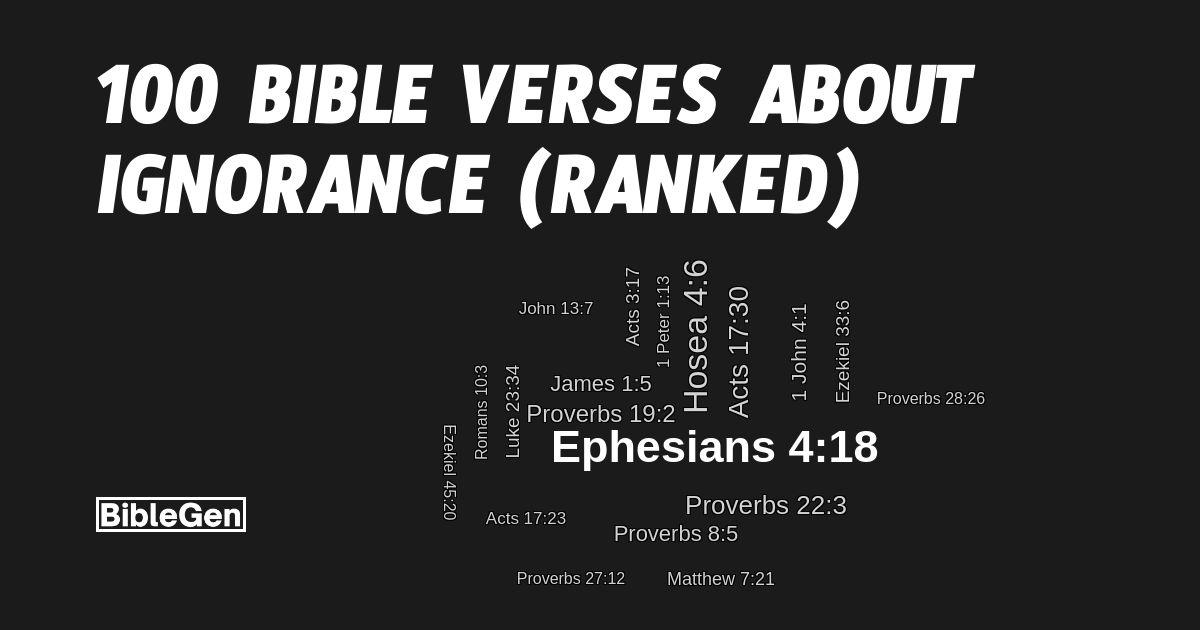
Ignorance, often perceived as merely a lack of knowledge, has profound implications within the tapestry of biblical teachings. Throughout the scriptures, the concept of ignorance is intertwined with themes of wisdom, responsibility, and moral accountability. This article will delve into the profound insights offered by the Bible on ignorance, encouraging reflection and sparking curiosity about this age-old dilemma.
The Bible begins its discourse on ignorance in the book of Proverbs, where wisdom is personified as a woman calling out to the simple and ignorant (Proverbs 1:20-23). It establishes a foundational premise: knowledge and understanding are not simply innate qualities but are pursued through diligence and a willing heart. Ignorance, therefore, is not merely an absence of knowledge but is often an active rejection of wisdom. This crucial distinction prompts an examination of one’s life choices, compelling individuals to confront their own naivety in the face of accessible enlightenment.
Furthermore, the notion of ignorance is intricately tied to the concept of sin. The Apostle Paul, in his epistles, elucidates that ignorance of the law does not absolve one from accountability. In Romans 2:12-16, he emphasizes that whether one has the law or not, all are subject to judgment based on their actions; ignorance can be perilous. This raises an important inquiry: to what extent does ignorance shield us from the moral repercussions of our actions? This biblical assertion challenges the reader to acknowledge that while ignorance may provide temporary solace, it ultimately bears significant consequences.
The Gospels further explore the ramifications of ignorance, particularly through the teachings of Jesus Christ. In Matthew 15:14, He admonishes His followers, stating, “Let them alone; they are blind guides. And if the blind lead the blind, both will fall into a pit.” This stark imagery serves to remind believers that ignorance, particularly when shared, can lead to collective downfall. The call for vigilance in seeking truth is loud and clear. Thus, one must ask: are we allowing ourselves to be led by unreliable sources? Are we blind to the larger truths of our existence that scripture so ardently illuminates?
Moreover, the Bible juxtaposes ignorance with enlightenment, underscoring a significant theme of transformation and renewal. In Ephesians 4:17-24, Paul urges a departure from the futility of the Gentiles’ minds, encouraging the faithful to embrace a new identity, “created to be like God in true righteousness and holiness.” Ignorance, in this context, is portrayed as a hindrance to spiritual growth and authenticity. It signifies a life unexamined, devoid of pursuit for deeper understanding. This juxtaposition invites introspection: in what areas of our lives are we remaining blissfully ignorant, forfeiting the opportunity for spiritual and ethical growth?
The Bible also offers a profound reflection on the nature of ignorance in relation to sin and redemption. In Acts 17:30, Paul proclaims, “In the past God overlooked such ignorance, but now he commands all people everywhere to repent.” Here, a shift occurs—from a state of passive acceptance to an urgent call for active repentance. Ignorance, once seen as a benign state, transforms into a catalyst for change. Revelation occurs not merely through the acknowledgment of our ignorance but through the subsequent pursuit of enlightenment and conscientious living. In this light, ignorance can be seen as a divine invitation to repent and seek knowledge, thus transforming our human experience.
As one navigates through the biblical texts, it becomes evident that ignorance is not merely an intellectual deficiency but a profound spiritual malady. Hosea 4:6 states unequivocally, “My people are destroyed for lack of knowledge.” Here, knowledge is portrayed as a protective agent; the absence thereof results in destruction. This powerful assertion beckons the faithful to introspect: are we nurturing ignorance in our lives? It is an urgent reminder of the cost associated with lack of awareness, emphasizing that the pursuit of knowledge is not just beneficial but essential for spiritual survival.
Further, ignorance can also breed apathy, which is a troubling state for any believer. In 1 Peter 2:15, the scripture states that it is God’s will that by doing good, you should silence the ignorant talk of foolish people. This verse highlights the importance of actively countering ignorance—not just within ourselves but also in our communities. It urges believers to commit to action and service, demonstrating that knowledge can be transformative, fostering connection and understanding. The challenge remains: how do we silence the ignorance surrounding us? And in what bold ways can our understanding illuminate the paths for others?
In the quest for understanding, the Bible encourages a lifelong journey toward enlightenment and wisdom, urging adherents to move beyond complacency. Ignorance, while initially comforting in its simplicity, ultimately obstructs the path to truth. As one grapples with the depths of ignorance, the scriptures provide a clarion call to pursue wisdom fervently, embrace humility in learning, and engage with the truth of God’s word. This journey leads not only to individual transformation but also to a richer, more compassionate community that recognizes the importance of informed living.
In conclusion, the teachings of the Bible on ignorance illuminate a path toward greater understanding and spiritual awakening. Rather than viewing ignorance as an innocent state, one is called to recognize its gravity and potential for destruction. Embracing the promise of knowledge and the importance of inquiry fosters a rich spiritual landscape, wherein believers may thrive in true wisdom and righteous living. It is an invitation—to shift perspectives, elevate consciousness, and engage in the profound journey of lifelong learning.

