

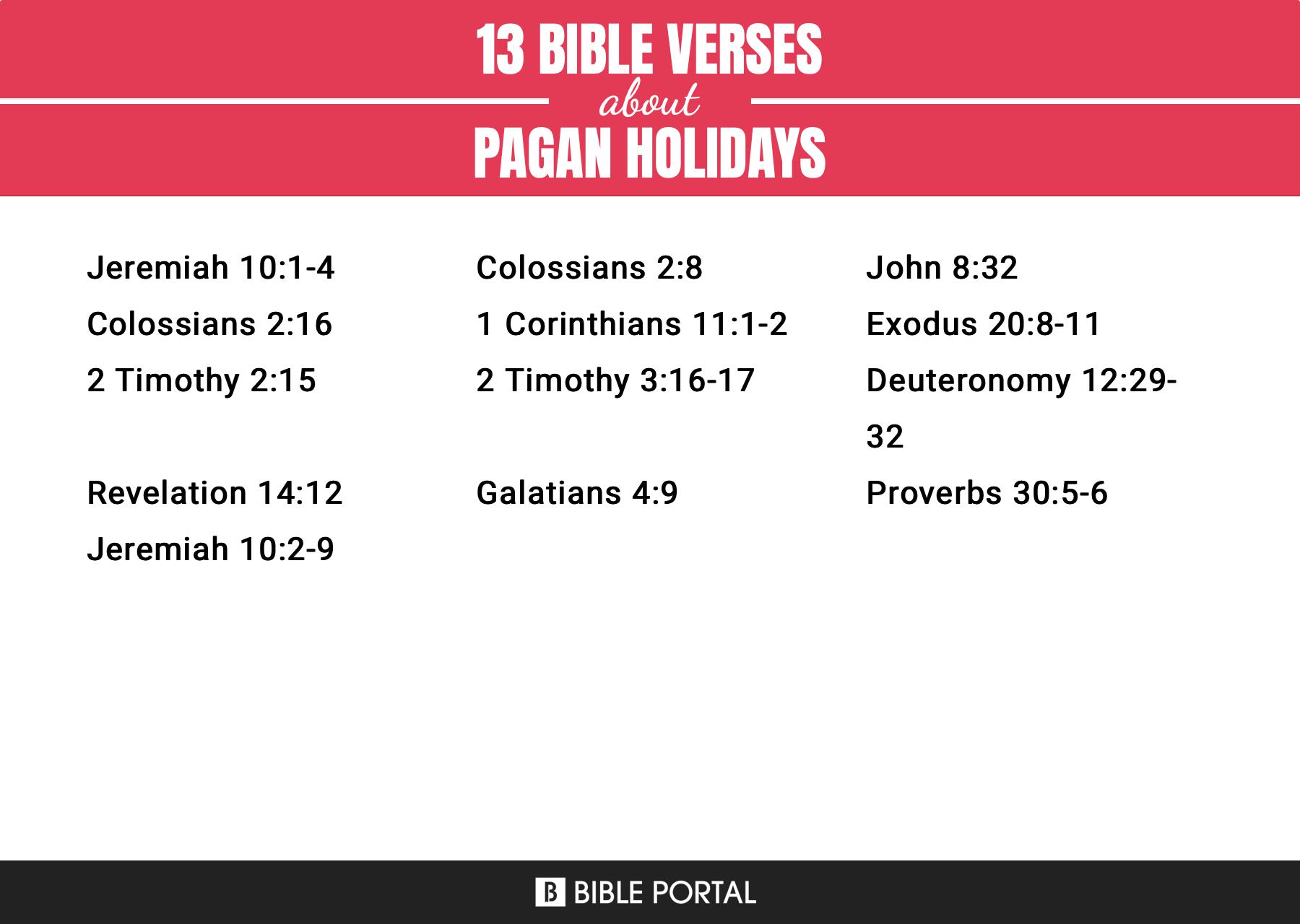
Throughout history, humans have celebrated various holidays, many of which have roots in ancient pagan traditions. As these celebrations have traversed cultures and time, they often bear witness to the intricate tapestry of human spirituality. But what does the Bible convey regarding these pagan holidays? This inquiry transcends mere religious doctrine; it touches the essence of identity, cultural amalgamation, and spiritual adhesion.
To begin, it is crucial to discern the biblical perspective on paganism itself. The scriptures reveal a profound dichotomy between the worship of Yahweh and the idolatrous practices prevalent among ancient nations. One prevalent theme in the Bible is the admonition against serving other gods. Exod. 20:3 explicitly commands, “You shall have no other gods before me.” Such proclamations underline not just a religious directive but also an invitation to explore the deeper implications of fidelity and allegiance.
Interestingly, festivities often associated with pagan traditions, such as harvest celebrations or solstice events, were not inherently evil in their essence. In Deut. 16:14, the Israelites are commanded to celebrate during the harvest season, reflecting a divine correlation between gratitude and the cycles of nature. However, what turns these celebrations into pagan holidays are the rituals and customs entangled with idolatry and false worship. Therefore, the Bible does not categorically dismiss joy and celebration; rather, it underscores the significance of these events being rooted in acknowledgment of the Creator.
One cannot overlook the entrenchment of cultural influences on religious practices. As Christianity triumphed over paganism in various regions, many pagan customs were assimilated into Christian festivities. This syncretism birthed complex holidays that retain echoes of their ancestral roots. Take, for example, Christmas, which, while a significant Christian celebration of the birth of Jesus Christ, overlaps with winter solstice traditions and pagan rituals. This coexistence can lead to a rich, albeit contentious, discourse on authenticity in worship.
Furthermore, the notion of proximity to nature in pagan festivals resonates with a fundamental aspect of human existence. Many biblical passages, such as Psalm 104, celebrate the bounteousness of creation. The Bible encourages humanity to revel in the earthly delights that God has provided. Thus, while pagan holidays are often scrutinized, their intrinsic connection to the natural world reflects a yearning for communion with creation, a theme deeply embedded in the biblical narrative.
Moreover, the secular reinterpretation of these holidays raises questions about spiritual integrity. How much of a holiday is retained when one strips away its original context? For instance, Halloween, which has roots in ancient Celtic traditions, evolves into a celebration markedly devoid of its pagan undertones for many today. Yet, the spiritual significance still lingers in its practices, an undercurrent that cannot easily be dismissed. In Ephesians 5:11, believers are urged to “take no part in the unfruitful works of darkness,” highlighting the necessity for discernment in how celebrations may juxtapose with one’s faith.
In conclusion, grappling with the topic of pagan holidays in the light of biblical teachings necessitates a contemplative approach. It is not solely a matter of condemnation or acceptance, but rather a nuanced understanding of the intersection between culture, spirituality, and human expression. The Bible invites exploration, discernment, and a profound respect for the diverse practices that have shaped our collective history. Ultimately, the true challenge lies in aligning our celebrations with a heart that honors the divine, steering clear of mere external conformity while embracing the essence of devotion.

