

The concept of “uncleanness” in the Bible is intriguing, nuanced, and often misinterpreted. To the modern reader, passages in the Book of Leviticus pertaining to what is deemed “unclean” may initially appear as arbitrary ancient regulations. However, beneath this perception lies a rich tapestry of cultural, religious, and moral significance that deserves exploration.
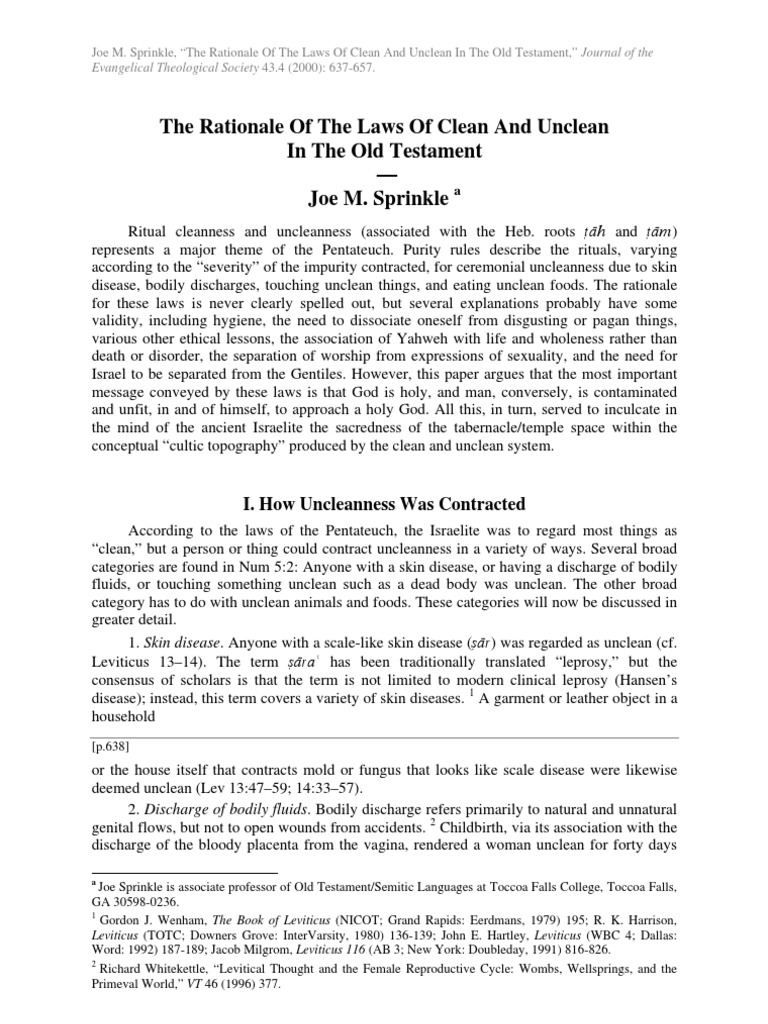
At its core, the term “unclean” arises primarily within the context of the Levitical laws, which serve not just to guide ritualistic practice but also to delineate boundaries concerning purity and holiness. The Israelites, upon receiving these laws, were instructed on the distinctions between the sacred and the profane. This separation was essential for cultivating a sense of communal identity and understanding one’s relationship with the divine.
These laws were not merely punitive; rather, they acted as a mechanism for social cohesion. Certain animals were labeled as “unclean”—such as pigs and scavengers—because they were thought to embody traits that were opposed to the moral and spiritual aspirations of the community. Engaging with prohibited foods, or failing to observe cleanliness rituals, suggested a disregard for the divine order. Consequently, one’s physical state was a reflection of their spiritual condition. This became a point of profundity: how one maintained purity was deeply intertwined with their holistic wellbeing.
Moreover, the idea of being unclean encapsulates more than just a classification of physical states; it also alludes to moral and ethical implications. For instance, bodily fluids, such as blood or menstrual discharge, carried a notion of spiritual danger and contamination. By ritualistically isolating those considered unclean during specific periods, the text emphasizes a larger principle: the importance of acknowledging and respecting the natural processes of life and death. There is something transformative about this acknowledgment; it is a recognition of the cyclicality within the human condition.
The fascination surrounding these stipulations lies not solely in their historical context but in their enduring relevance. Many contemporary discussions pivot around the concept of cleanliness in various cultures. How societies define purity varies widely and is often a reflection of their values. For some, cleanliness is associated with health and hygiene, a necessity in modern society. Yet, in spiritual and religious contexts, it evokes deeper themes of morality, ethics, and even justice.
In addition to physical states, the Bible also speaks to the notion of “unclean” through spiritual terms. For example, in the New Testament, Jesus frequently challenged conventional definitions of purity. By healing the sick and dining with sinners, he reframed uncleanliness from a set of rigid laws to an opportunity for compassion and redemption. Through his actions, Jesus demonstrated that the essence of cleanliness transcends mere physicality; it reaches into the depths of the heart and spirit.
Thus, examining the biblical concept of uncleanness reveals a broader understanding of humanity’s struggles, desires, and aspirations. It invites a nuanced discussion about societal norms and how they shape our interactions with others. Far from being a mere product of ancient rituals, the biblical discourse on uncleanness serves as a profound reflection of human complexities, bridging the gap between the sacred and the profane, the lofty and the mundane.
In conclusion, the biblical understanding of what it means to be unclean raises questions that remain pertinent today. Engaging with these ancient texts unlocks new dimensions of thought regarding purity, morality, and the human experience. It beckons us to consider how we, as individuals and as a society, navigate the intricate balance between our internal states and the external judgments imposed upon us.

