

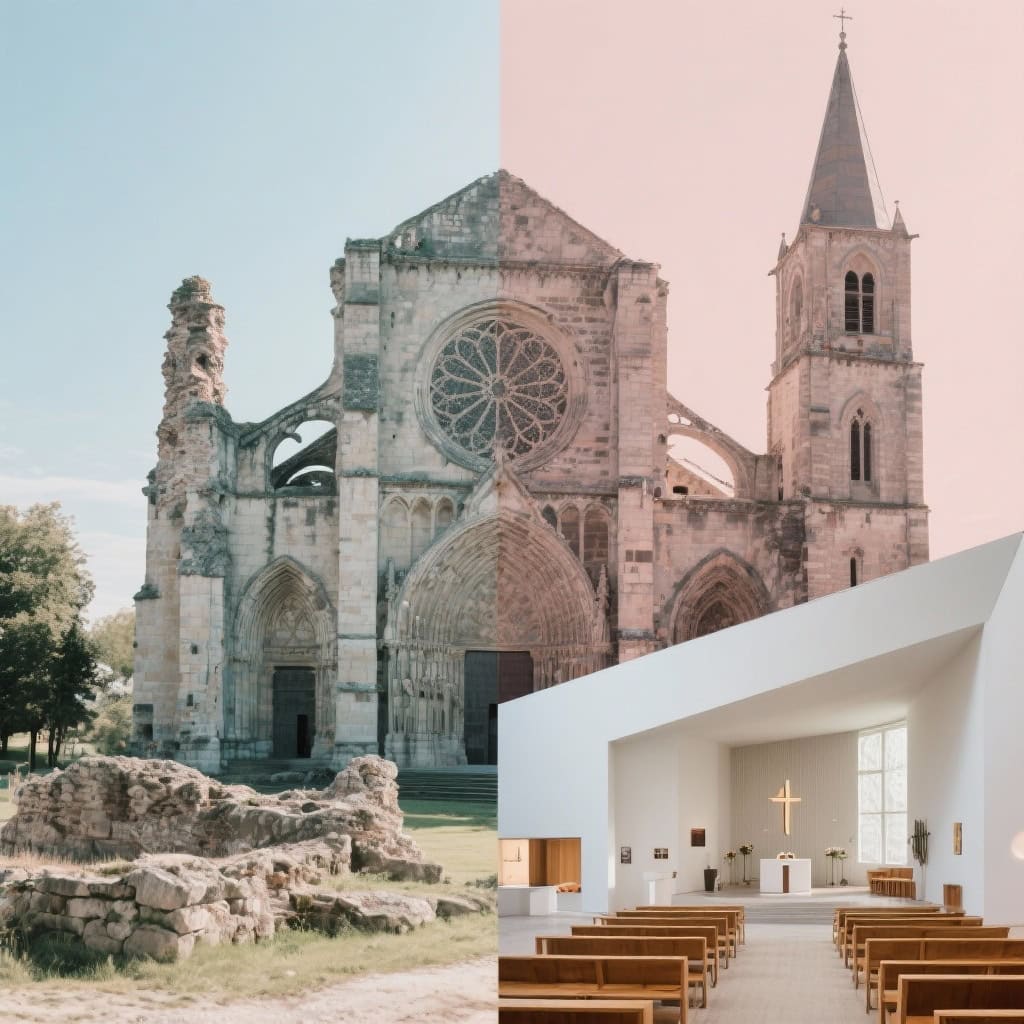
In the grand cathedral of human spirituality, two architectural titans stand side by side, each echoing a distinct hymn to the divine. One, a bastion of time-honored stone and stained glass, whispers of centuries past with every vaulted ceiling and flickering candle. The other, a sleek sanctuary of glass and steel, hums with the rhythm of modern life, its melodies pulsed through digital amplifiers. The Traditional Church and the Contemporary Church are not merely buildings; they are living organisms, each with a heartbeat that resonates with the souls who gather within their walls—or in the virtual spaces they now occupy. To understand their unique appeal is to embark on a journey through the soul of worship itself, where the past and present engage in a timeless dance.
The Timeless Elegance of Tradition: A Sanctuary of Sacred Echoes
Step into a Traditional Church, and you are immediately enveloped in a world where time moves in measured, deliberate strokes. The air is thick with the scent of aged wood, beeswax candles, and the faintest hint of incense, each aroma a silent testament to rituals passed down through generations. The architecture is a symphony of gothic grandeur or neoclassical symmetry, where every arch, column, and stained-glass window is a verse in an ancient poem written in stone and light. The stained glass is not merely decorative; it is a kaleidoscopic sermon, casting jewel-toned narratives of saints, martyrs, and biblical epics across the stone floor, turning sunlight into a living, breathing gospel.
Here, liturgy is not a performance but a pilgrimage. The liturgical calendar is a celestial clock, marking the passage of seasons with Advent’s expectant hush, Lent’s penitential austerity, and Easter’s jubilant crescendo. The congregation does not merely attend; it participates in a choreography of faith, where every genuflection, every whispered prayer, and every shared sign of peace is a thread woven into the fabric of tradition. The hymns, often centuries old, are not just songs but anthems of continuity, their melodies carrying the weight of generations who have sung them before. In this space, worship is not an event but an inheritance, a sacred trust passed from one soul to the next like a flickering candle in the dark.
The Traditional Church is a museum of the spirit, where every artifact—a carved pulpit, a baptismal font worn smooth by centuries of use, a pipe organ whose pipes sing with the breath of time—whispers of the unbroken chain of faith. It is a place where the past is not dead but alive, pulsing in the veins of the present. To worship here is to stand on the shoulders of giants, to feel the pulse of history in every heartbeat of the liturgy. It is a sanctuary for those who find solace in the familiar, who hear in the old hymns the echoes of their ancestors, and who find in ritual the rhythm that steadies their souls.
The Modern Pulse: Contemporary Worship as a Living Canvas
Now, step into a Contemporary Church, and the air hums with a different kind of electricity. The space is open, uncluttered, a blank canvas waiting to be painted with the vibrant hues of modern worship. The architecture is minimalist, often blending seamlessly with the world outside—glass walls that dissolve the boundary between sanctuary and sky, modular seating that rearranges like a living organism, and stages bathed in the glow of LED lights that pulse in time with the music. Here, technology is not an intrusion but an ally, amplifying voices, projecting lyrics onto screens like digital stained glass, and streaming sermons to those who cannot be present in body but are present in spirit.
The worship experience is a multimedia extravaganza, where the line between performer and congregation blurs into a shared act of creation. The music is a fusion of genres—rock anthems, folk melodies, electronic beats—each song a bridge between the sacred and the secular, the timeless and the timely. The sermons are conversational, often interactive, delivered with the cadence of a TED Talk or the raw authenticity of a fireside chat. Prayer is not confined to a set liturgy but erupts spontaneously, a river of voices rising like incense in the digital ether. The Contemporary Church is a laboratory of faith, where tradition is not discarded but reimagined, where the old is not buried but repurposed into something new and vital.
This is a space for the restless, for those who find God not in the hush of ancient halls but in the cacophony of modern life. It is a sanctuary for the digital native, the seeker who scrolls through scripture on a tablet as easily as they scroll through social media. The Contemporary Church speaks the language of the present, using the tools of the age to craft a worship experience that feels immediate, relevant, and alive. It is a place where faith is not a museum piece but a living, breathing entity, constantly evolving, constantly adapting. Here, the Holy Spirit is not confined to the pages of a hymnal but moves through the beats of a drum machine and the strum of an electric guitar.
The Heartbeat of Community: Where Tradition and Innovation Converge
Yet, for all their differences, Traditional and Contemporary Churches share a common heartbeat: the pulse of community. In the Traditional Church, community is woven into the fabric of ritual. The shared experience of kneeling at the altar, of passing the peace, of breaking bread together creates bonds that are as unshakable as the stone walls that surround them. It is a community of memory, where the stories of the past are told and retold, where the elderly teach the young the old hymns, and where the newcomer is enfolded into the warmth of generations-old friendships.
In the Contemporary Church, community is forged in the immediacy of shared experience. The worship experience is designed to be participatory, with interactive elements that invite the congregation to engage not just as spectators but as co-creators. Small groups meet in coffee shops or living rooms, discussing sermons over craft beer or lattes. Online communities gather in virtual spaces, praying together across time zones and continents. The Contemporary Church is a community of the present, where the bonds are forged in the crucible of shared passion, where the seeker and the skeptic alike find a place at the table.
But the most profound communities are those that bridge the gap between tradition and innovation. Imagine a church where the ancient hymns are reimagined with modern instrumentation, where the liturgy is streamed to those who cannot attend in person, where the stories of the past are told through the lens of the present. This is the church of the future—a hybrid space where the best of both worlds collide, where the unchanging truth of the gospel is proclaimed in the language of the age. It is a community where the young and the old, the traditionalist and the innovator, find common ground in the shared pursuit of the divine.
The Soul of Worship: Which Path Resonates?
The choice between Traditional and Contemporary worship is not a matter of right or wrong but of resonance. It is a question of where your soul finds its home. Do you hear the call of the past, the whisper of centuries of saints who have walked the same path before you? Do you find solace in the familiar, in the unchanging rhythms of liturgy and hymn? Then the Traditional Church may be your sanctuary, a place where the past is not a burden but a blessing, where every ritual is a thread connecting you to the great cloud of witnesses.
Or do you feel the pull of the present, the urgency of a world that moves at the speed of light? Do you find God in the raw, unfiltered moments of modern life, where faith is not confined to a building but erupts in the streets, in the digital spaces, in the everyday? Then the Contemporary Church may be your calling, a place where the gospel is proclaimed in the language of the age, where worship is not a performance but a conversation, where the Holy Spirit moves through the beats of a drum machine and the strum of an electric guitar.
Ultimately, the most profound worship experiences are those that transcend the boundaries of tradition and innovation. They are the moments when the ancient hymns are sung with new passion, when the liturgy is lived out in the streets, when the gospel is proclaimed not just in words but in deeds. Whether your heart beats in time with the past or the present, the true measure of a church is not its architecture or its music but its ability to foster a community where souls are nourished, where doubts are wrestled with, and where the divine is encountered in the most unexpected of places.

