

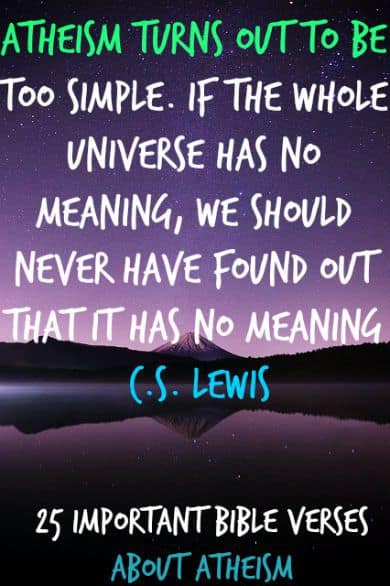
Atheism, often perceived as a stark void within the vibrant tapestry of faith, presents a unique vantage point for contemplation on the divine. Within the pages of the Bible, a multifaceted anthology of spiritual truths, there lies both a critique and a reflection on this worldview. To navigate the labyrinthine discourse on atheism as portrayed in scripture, one must delve into the depths of human introspection, questioning the very essence of belief and existence.
In examining what the Bible articulates about atheism, one cannot overlook the profound declaration found in Psalm 14:1: “The fool says in his heart, ‘There is no God.’” This encapsulation is not merely a disparagement; it is an invitation to ponder the dichotomy of wisdom and folly. The metaphor of foolishness serves as a lens through which to view the consequences of a life devoid of faith. This passage, saturated with a poetic gravity, urges individuals to contemplate the ramifications of disbelief—not merely on a personal level but in the larger narrative of humanity.
Moreover, the Bible does not shy away from exploring the anguish and existential crises that often accompany atheistic thought. Proverbs 3:5-6 encourages the believer to “trust in the Lord with all your heart and lean not on your own understanding.” This notion sharply contrasts with the atheistic reliance on empirical evidence and personal reasoning as the sole arbiters of truth. Herein lies a poignant metaphor: the heart as a compass, navigating through the fog of uncertainty. It proposes that there exists a dimension of understanding beyond human cognition, a divine intelligence orchestrating the nuances of existence.
The New Testament, too, adds layers to the discourse on atheism. Romans 1:20 discusses how “since the creation of the world, God’s invisible qualities—his eternal power and divine nature—have been clearly seen.” This passage suggests that even in moments of doubt, the grandeur of creation serves as an intrinsic testament to a higher power. The metaphor of nature as a grand canvas suggests that the divine artist is ever-present, nudging humanity toward recognizing an omnipotent creator.
This exploration deepens further with the juxtaposition between faith and doubt. The Bible portrays doubt not as a weakness but as a catalyst for growth. The narrative of Thomas, often dubbed “Doubting Thomas,” encapsulates this journey. Christ’s invitation to Thomas to touch His wounds is a vivid metaphor for the reconciliation between doubt and belief. It illustrates that in the act of questioning lies a profound opportunity for spiritual awakening, a notion that resonates with the experiences of those struggling with atheistic ideologies.
In essence, the scriptural references to atheism prompt profound introspection and dialogue, challenging readers to consider the broader implications of their beliefs or skepticism. Rather than a mere admonition against disbelief, the Bible invites discussions on knowledge, existence, and the intrinsic human longing for purpose. It elegantly intertwines metaphors of folly, wisdom, creation, and doubt, creating a profound tapestry that reflects the complexities of the human condition.
In forging a bridge between faith and doubt, the Bible critiques atheism while simultaneously acknowledging the struggles that accompany such a worldview. It serves as a beckoning call to explore, question, and ultimately, to seek—reflecting an undeniable truth: that the search for meaning is an integral part of humanity’s journey, transcending the boundaries of belief and skepticism alike.

