

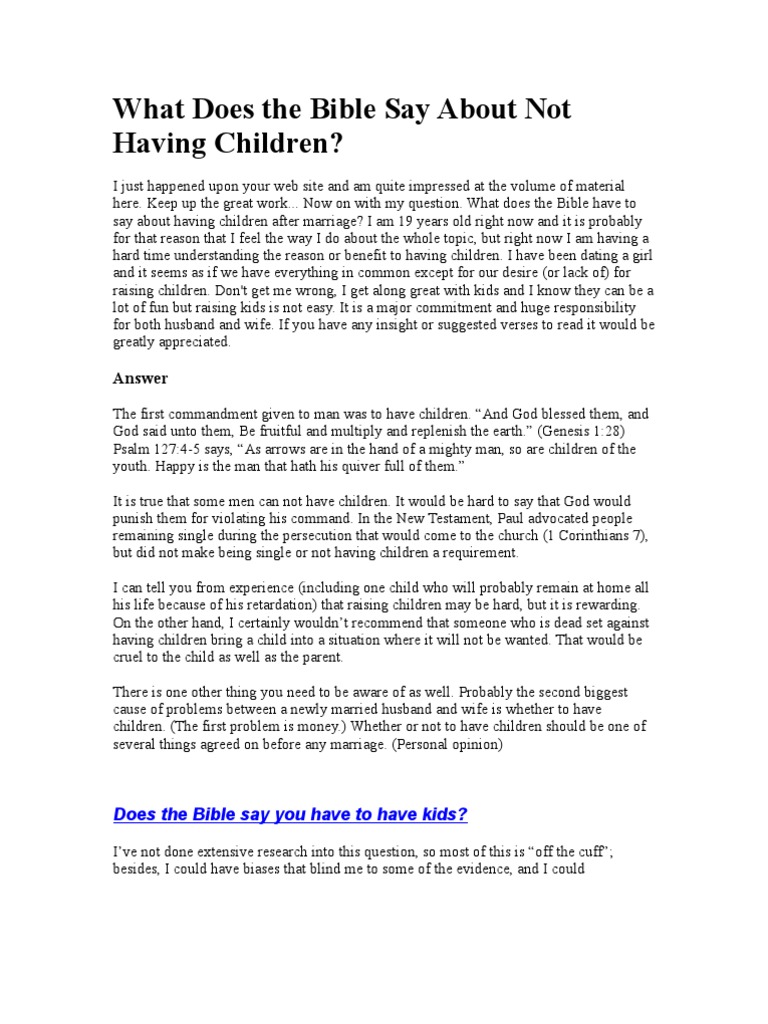
At the confluence of faith and familial choices lies a pertinent question that rustles through the hearts and minds of many: What does the Bible say about having children? This inquiry transcends mere curiosity; it embodies a societal dialogue, an intricate exploration of personal decisions swathed in theological implications. Ancient texts bear witness to the intimate connections between divine promises, human choice, and the perpetuation of life.
Within the pages of the Bible, one finds a tapestry interwoven with narratives that extol the virtues and responsibilities of parenthood. The act of procreation is not merely biological; it reverberates with spiritual significance. The very first commandment bestowed upon humanity, “Be fruitful and multiply, and fill the earth,” embodies a divine mandate that echoes through generations (Genesis 1:28). This imperative reveals a profound truth: children are perceived as blessings, not burdens.
Consider the case of Abraham, a figure whose name has transcended the centuries, symbolizing faith and obedience. Promised innumerable descendants, Abraham’s covenant with God (Genesis 17:1-5) encapsulates the essence of divine intentions in human relationships. His journey reflects an unwavering faith despite trials, beckoning the question of trust in divine timing—an intricate dance between the promise of offspring and the realities of life’s unpredictability.
Yet, the Bible also engages with the agonizing plight of those unable to conceive. The stories of Sarah, Rachel, and Hannah serve as poignant reminders that the path to parenthood can sometimes be shadowed by sorrow. Sarah, who bore Isaac in her old age, exemplifies hope amidst despair. Her laughter at the prospect of conceiving (Genesis 18:12) echoes the complexities of faith confronting reality. Rachel’s tears and lamentation reflect the poignant pain of yearning for children, illustrating that the desire for progeny is deeply human, resonating through the ages.
Moreover, the Biblical narrative invites readers to consider the notion that the value of children transcends mere biological ties. Psalm 127:3-5 poetically elucidates, “Children are a heritage from the Lord, offspring a reward from Him.” This sentiment reframes the conversation. Children are not merely personal extensions but blessings that enrich one’s life. The verses remind faith followers that each child, regardless of means of conception, embodies potential and purpose, enhancing the familial unit and enriching societal fabric.
In juxtaposition to this heritage lies the stirring query of stewardship. Are we, as caretakers of life, truly prepared to shoulder this sacred responsibility? The Bible doesn’t shy away from this reflection. The moral imperative surrounding child-rearing is highlighted in Ephesians 6:4, where parents are urged not merely to discipline but to nurture children with wisdom and love. Loving guidance transforms homes into havens, instilling virtues that echo through the corridors of time.
Furthermore, as societal norms shift and family structures evolve, the Bible’s teachings offer a lens through which to view modern dilemmas regarding family planning. In an age where birth control and reproductive choices are pervasive topics, the faithful might reflect upon the theological implications of such choices. The scriptural perspectives call for contemplation, urging individuals to align their decisions with a broader understanding of life’s sanctity.
The biblical exhortation to “love your neighbor” extends into the realm of parenthood. It challenges the reader to consider the societal ramifications of decisions regarding children. Engaging with the world’s pressing challenges—including environmental sustainability, economic stability, and equitable access to resources—begins within the family unit. Raising children who embody compassion and responsibility can address future crises, directing generations toward a more ethical and moral society. Thus, in recognizing that the act of rearing children carries weighty social ramifications, the Biblical message burgeons with contemporary relevance.
The concept of community is intricately linked to the biblical understanding of family. The early church models an inclusive approach, where familial bonds extend beyond biological lines, promoting a notion of communal upbringing (Acts 2:44-47). This perspective fosters a reimagining of parenthood whereby families intertwine with broader communities, enriching children’s lives through shared experiences and collective wisdom. In this light, having children transforms from a personal blessing to a shared commitment—one in which communities rally together to nurture the next generation.
As we navigate discussion of children through a biblical lens, we must also confront the various motivations that shape this significant choice. Some may feel a divine calling to raise children, seeking to instill faith and values deeply rooted in scripture. Others may opt for a life unencumbered by parenthood, pursuing passions that extend beyond traditional familial paths. Both choices warrant respect and contemplation, as each reflects a unique journey through life’s intricate tapestry.
In conclusion, the biblical teachings on having children invoke a deep reflection on the interplay of divine promise, societal responsibility, and personal choice. The narrative unfolds a rich understanding of parenthood as a sacred journey that requires thoughtful deliberation, a commitment to stewardship, and a recognition of interconnectedness with the community. As believers grapple with their individual paths, the Bible remains a wellspring of wisdom, inviting a nuanced exploration of family, faith, and the complexities of life’s greatest treasure: children.

