

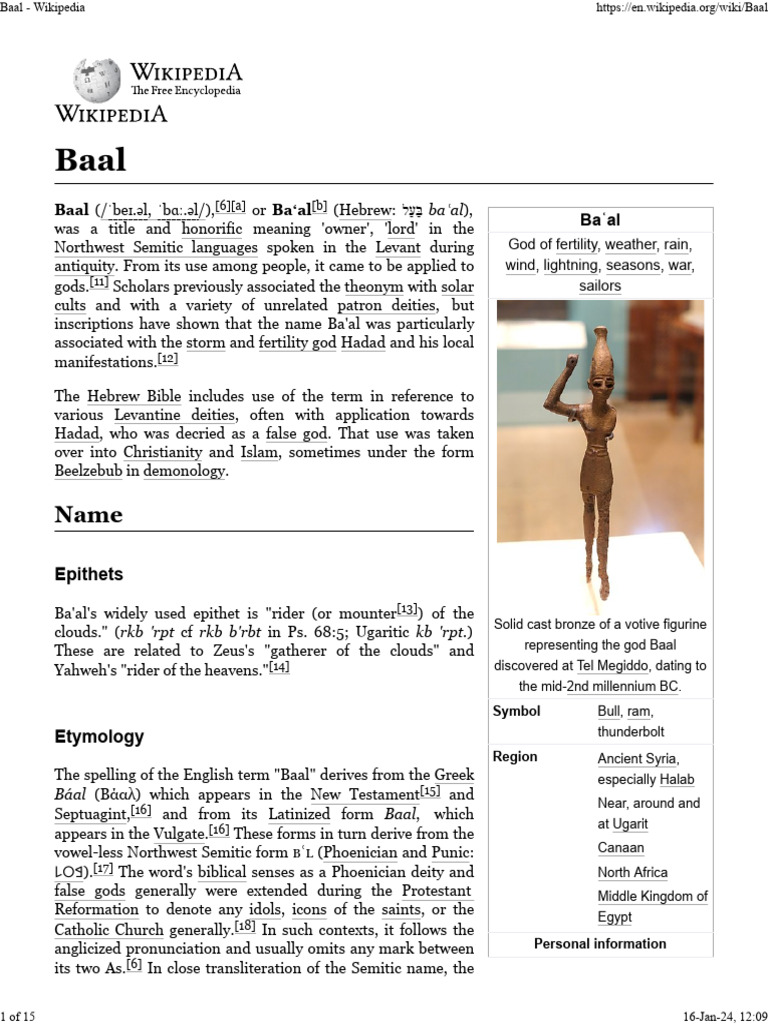
In the annals of ancient religious thought, few deities have carried the weight of cultural and moral dichotomy as strikingly as Baal. Often regarded with trepidation and reverence, this name conjures images of a being wrapped in layers of complexity, myth, and societal reflection. To fathom what Baal symbolizes in the Bible invites us into realms of history, spirituality, and theological interpretation. Herein lies an exploration of his significance, the backdrop of his worship, and the pertinacious tensions woven through his narrative.
At its essence, Baal is a term that transcends mere nomenclature; it embodies a pantheon of gods worshipped in ancient Near Eastern cultures, particularly among the Canaanites. The name itself translates to “lord” or “master,” indicative of its reverential usage. This term was not confined to a single entity but rather encapsulated various manifestations that represented fertility, storms, and agriculture. Such attributes align Baal with the earth’s cyclical rhythms, making him a critical figure for agricultural societies reliant on the benevolent whims of nature.
As the wind rustles through the fields, one can almost hear the prayers of farmers beseeching Baal for rain—a coaxing of the divine for sustenance. This dependence on his favor elevated Baal to a significant status, mirroring the relationship humanity maintains with nature: complex, fraught with fear, but fundamentally essential.
In the biblical narrative, Baal emerges not only as a deity of the pantheon but as an adversary to the worship of Yahweh, the unique and singular God of Israel. This juxtaposition establishes a central conflict within biblical texts. The Israelites, amidst their journeys and tribulations, oscillated between fidelity to Yahweh and flirtations with Baal worship, leading to moral and existential crises. Such fervent oscillation signals an intrinsic human struggle—yearning for stability yet tempted by the allure of immediate satisfaction and empirical evidence of divine favor.
The Book of Judges paints a vivid tableau of this tension. In tales of apostasy, the Israelites abandon Yahweh and embrace Baal, engendering divine wrath and subsequent punishments. One can visualize the relentless cycle of sin and redemption: the heart that strays from its true north, only to return when faced with desolation. In this narrative, Baal serves as a metaphor for all that seduces yet ultimately disappoints the soul. His allure is immediate—much like sinful temptation—but the repercussions of his worship bring social and spiritual desolation.
Baal worship encapsulated a pantheon of rituals, many of which revolved around fertility rites and agricultural cycles. The Canaanite practices often involved ecstatic celebrations, sacrifices, and rituals designed to coax favor and abundant harvests. However, from a biblical perspective, these rituals are depicted as abominations, a dark echo of their inherent disobedience to Yahweh’s commandments. The prophets of Israel vocally opposed Baal worship, seeing it as a betrayal of their covenant with the one true God.
Among the most striking figures in this biblical opposition is the prophet Elijah, who stands confrontationally on the precipice of Mount Carmel. There, he orchestrates a challenge between Yahweh and Baal, compelling the prophets of Baal to call upon their god to ignite a sacrificial offering. The dramatic veracity of this moment encapsulates the confrontation of faith. As the prophets of Baal dance and plead, no fire descends, a stark presentation of divine impotence. In contrast, Elijah’s humble prayer ignites a consuming fire, showcasing Yahweh’s unparalleled power. This vignette offers a poignant reminder: the nature of true divinity far surpasses the superficial charms of false gods.
Yet, for all his malevolent portrayals, Baal elicits a dual nature. His representation speaks not solely of wickedness, but rather illustrates the underlying desires and fears of humanity—the longing for control over one’s environment and fate. In Baal’s strange and appealing mystique lies a reflection of humanity’s age-old dance with powerlessness. In an epoch where existential despair looms omnipresent, the pull towards tangible, albeit fleeting, satisfaction springs from a deep-seated yearning for certainty in life’s tempestuous journey.
The biblical narrative ultimately positions Baal as a cautionary tale. An empirical god of the senses, he serves as a metaphor for the ephemeral distractions that tempt the heart away from higher, more transcendent truths. This allegory resonates with profound modern implications. Humanity still grapples with its ‘Baals’—those distractions, pleasures, and ideologies that sidetrack from higher virtues and a more profound sense of purpose.
In conclusion, the exploration of Baal in the Bible unfolds as a narrative rich with symbolism and moral contemplation. It invites reflections on loyalty, societal values, and the incessant pull between immediate gratification and spiritual fulfillment. Baal, as a character in this intricate tapestry, underscores not only the challenges of ancient peoples but resonates deeply with the spiritual struggles faced in contemporary society. This enduring dialogue between the ephemeral and the eternal is what keeps the story of Baal pertinent and haunting—a metaphorical warning of the allure of false idols amid life’s mutable landscape.

