

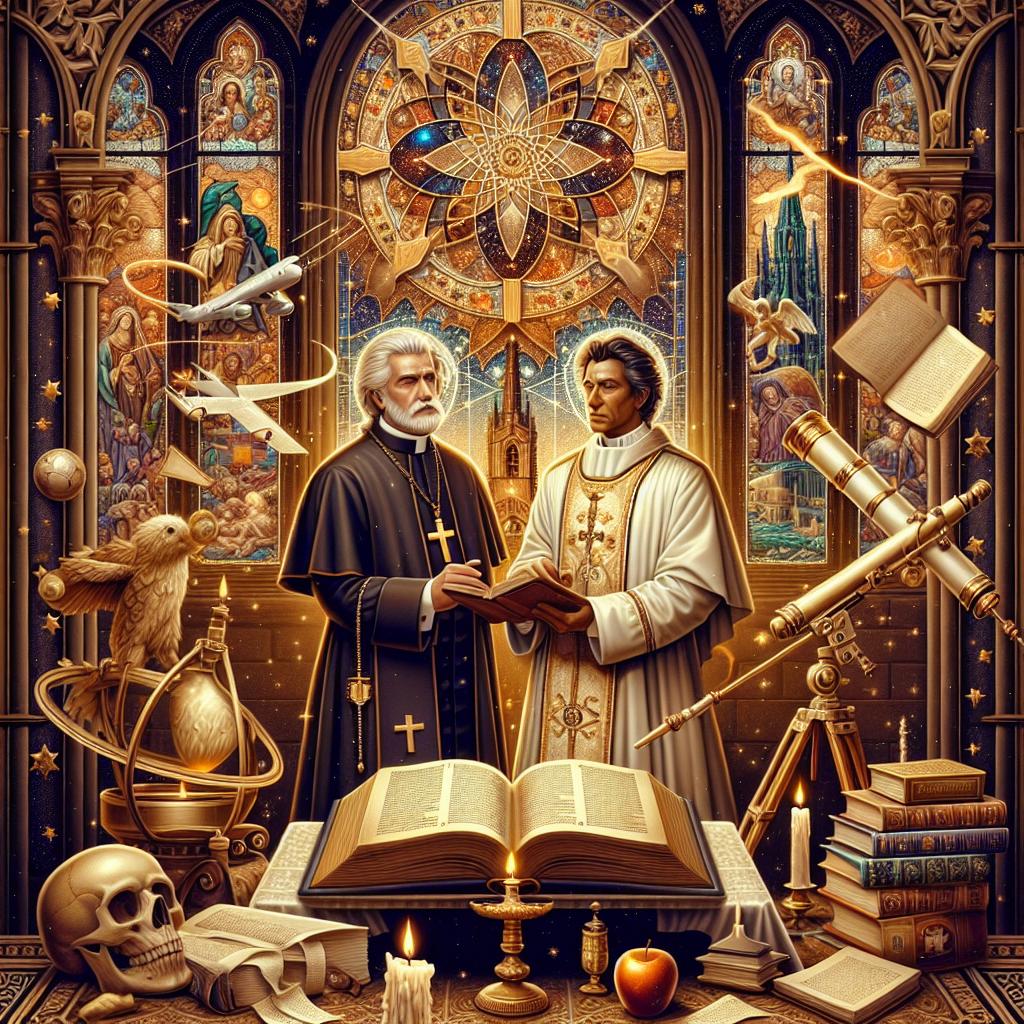
Can a cathedral’s soaring arches and a particle accelerator’s humming tunnels truly coexist on the same intellectual horizon? This playful question sparks a debate that has flickered through centuries, challenging believers and empiricists alike to reconcile the sacred with the quantifiable. The tension is not merely academic; it touches the core of how humanity narrates its origin, purpose, and destiny.
Historical Synergy: When Monks Mapped the Heavens
In the early medieval cloisters, monks were the custodians of both scripture and scientific observation. Their meticulous copying of ancient texts preserved Ptolemaic astronomy, while their botanical gardens nurtured early botany. The Benedictine tradition advocated ora et labora—prayer and work—fostering an environment where natural philosophy flourished alongside liturgy. Monasteries became de facto research institutes, producing scholars such as Bede, who calculated the date of Easter with startling precision, and Roger Bacon, whose experiments prefigured the scientific method.
The Age of Reason and the Rift: Galileo, Gravity, and Divine Authority
The Scientific Revolution ignited a seismic shift. When Galileo Galilei turned his telescope toward the moons of Jupiter, he witnessed a cosmos that defied geocentric orthodoxy. The Church, fearing doctrinal erosion, responded with admonition; the Inquisition forced Galileo to recant. This episode etched a lasting narrative of conflict, yet it also underscored a latent dialectic: authority versus evidence. The collision was not simply ideological; it was a clash of hermeneutic frameworks, each vying to interpret reality through distinct lenses.
Theological Foundations and Epistemic Dissonance
Faith and empirical inquiry operate on different ontologies. Theological discourse privileges revelation, tradition, and the sacramental mystery, whereas science pursues hypothesis, experimentation, and falsifiability. This epistemic dissonance can produce a metaphysical scaffolding that appears mutually exclusive. Yet, as thinkers like Thomas Aquinas illustrated, reason can illuminate doctrine; natural theology attempts to locate God’s footprints within the laws of nature. The notion of “necessary existence” or “uncaused cause” still reverberates in contemporary debates about the origins of the universe.
Modern Dialogue: From Papal Pronouncements to Vatican Observatories
In recent decades, the Church has actively sought rapprochement. Pope John Paul II’s 1992 address to the Pontifical Academy of Sciences acknowledged the legitimacy of evolutionary theory, stating that truth cannot contradict truth. The Vatican Observatory, a bastion of astrophysical research, continues to publish peer‑reviewed studies on cosmology, demonstrating that celestial inquiry can coexist with doctrinal commitment. Interfaith panels now convene to discuss quantum gravity, dark matter, and the伦理 of genetic editing, illustrating a willingness to engage with cutting‑edge science rather than retreating into isolation.
Evolution, Big Bang, and the Challenge of Teleology
One of the mostthorny arenas of compatibility is the dialogue between evolutionary biology and creationist narratives. The Big Bang theory posits a singular inception event, a concept that many theologians eagerly adopt as a scientific corroboration of ex nihilo creation. Conversely, the mechanistic randomness in Darwinian evolution can seem to undermine purposeful design. Yet, a nuanced view suggests that evolution may be a process guided by a transcendent intelligence, rather than a blind watchmaker. This perspective retains teleological language without negating empirical evidence, offering a bridge across the apparent chasm.
The Promise of a Unified Vision: Future Horizons
As interdisciplinary research expands, the prospects for a unified worldview grow more tantalizing. Emerging fields such as neurotheology explore how neural correlates of religious experience inform philosophical anthropology. Quantum cosmology probes the very foundations of spacetime, echoing mystical contemplations of infiniteBecoming. By cultivating mutual respect—acknowledging the limits of both doctrine and data—science and faith can co‑author a richer narrative of existence. The challenge, then, is to nurture an epistemic humility that embraces mystery without fearing inquiry.


