

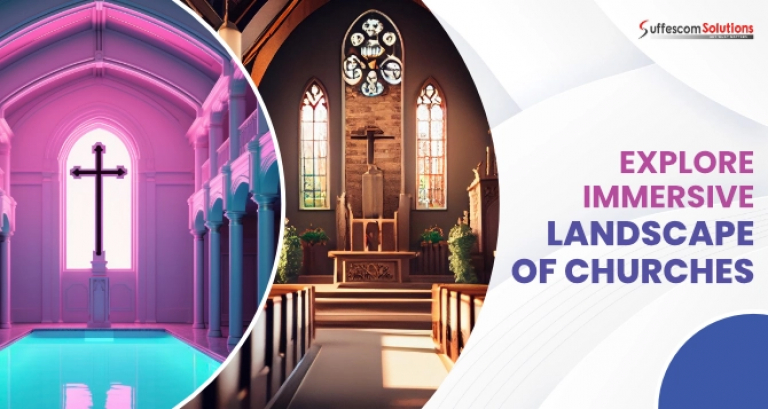
The sanctuary has long been a stone-and-mortar haven, but today its echo reverberates through pixel‑clad corridors where believers don avatars to pray. In the Metaverse, worship is no longer bound by geography; it spills across continents, inviting the faithful to gather in luminous digital cathedrals that pulse with the same yearning for transcendence that has stirred humanity for millennia. This convergence of ancient ritual and immersive technology offers churches a radical new frontier—one teeming with opportunities for outreach, community building, and liturgical experimentation, yet fraught with ethical dilemmas and technical hurdles that demand careful navigation. The following exploration delineates the manifold dimensions of this evolving landscape, offering insight into how faith communities can harness the potential of virtual worlds without sacrificing the depth of their spiritual mission.
Reimagining Sacred Geography in Virtual Worlds
In the Metaverse, space is not merely a backdrop; it is a malleable canvas that can be sculpted to echo the sacred narratives of a congregation. A church may commission a sprawling cathedral rendered in high‑definition meshes, complete with soaring arches, flickering stained‑glass windows, and ambient soundscapes that simulate reverberant acoustics. Parishioners step into this environment through VR headsets or web‑based avatars, their movements tracked in real time, allowing for spontaneous gestures of reverence—kneeling, bowing, or lighting virtual candles. Such immersive environments dissolve the constraints of physical seating capacity, opening doors to thousands who might otherwise be excluded by distance, disability, or socioeconomic limitation. Yet the transformation of spatial perception also raises questions: when a sacred site is wholly digital, does its sanctity depend on the authenticity of its architecture, or does the intention of the community confer holiness upon the construct?
Crafting Liturgical Expressions for the Digital Realm
Liturgy, the structured prayer and ritual that undergirds communal worship, can be re‑engineered to exploit the affordances of a virtual platform. Elements such as responsive lighting, real‑time particle effects, and interactive sacraments—like a virtual baptismal font that fills with luminescent water—invite participants to engage multisensorially. Pre‑recorded or live‑streamed homilies can be augmented with immersive storytelling, projecting biblical scenes onto a volumetric canvas that surrounds the congregation. The challenge lies in preserving the mystery and solemnity that define sacred rites while embracing the playful interactivity endemic to digital spaces. Liturgical designers must balance reverence with novelty, ensuring that innovations serve the theological narrative rather than merely showcasing technological flair.
Pastoral Care Across the Ether
Pastoral care extends beyond Sunday services; it encompasses counseling, prayer, and ongoing spiritual guidance. In the Metaverse, ministers can offer real‑time, avatar‑mediated conversations, enabling a sense of presence that mimics face‑to‑face interaction. Virtual counseling rooms can be equipped with calming visual cues—soft ambient lighting, nature‑inspired textures—that foster a safe environment for confession or grief. Moreover, AI‑driven chatbots can provide preliminary scriptural support, answering FAQs about faith or directing seekers to human pastors for deeper dialogue. Yet the intimacy of pastoral relationships can be strained by the mediation of screens, necessitating protocols that protect confidentiality, maintain clear boundaries, and honor the dignity of each soul in digital encounters.
Theological Dialogue on Avatar‑Mediated Presence
Christian anthropology traditionally affirms the body as integral to the self, yet the metaverse presents a radical extension: an avatar that stands in for the physical body

