

The sanctuary hums with a sacred resonance, where every object, every note, every gesture becomes a thread in the grand tapestry of worship. Here, the invisible becomes visible through the alchemy of music and ritual. The church is not merely a building; it is a living organism, a vessel of divine encounter where the mundane is transfigured into the eternal. Tools for music and liturgy are not mere accessories—they are the heartbeat of this spiritual symphony, the silent yet eloquent voices that guide the faithful into the presence of the sacred. From the resonant depths of the pipe organ to the delicate whisper of a censer’s smoke, each element serves a purpose, each sound carries meaning, and every ritual unfolds like a story written in the language of heaven.
The Pipe Organ: The Colossus of Sacred Sound
Standing like a Gothic titan at the heart of the nave, the pipe organ is more than an instrument—it is a cathedral within a cathedral. Its thousands of pipes, each a voice in its own right, rise in towering ranks, their metallic throats singing in harmonies that shake the rafters and stir the soul. The organist, a maestro of the sacred, coaxes from this behemoth a spectrum of tones that can thunder like judgment or sigh like a penitent’s plea. The organ’s sound is not merely heard; it is felt, vibrating through bone and sinew, a physical manifestation of the divine. It is the voice of the church itself, a sonic bridge between earth and heaven.
Consider the mechanics of its magic: air, forced through reeds and pipes of varying lengths, produces notes that resonate in perfect mathematical precision. The longer the pipe, the deeper the voice; the shorter, the higher the cry. This hierarchy mirrors the celestial order, where each voice—whether angelic choir or human congregation—finds its place in the grand chorus. The organ does not play; it preaches, its music a sermon without words, a language older than speech itself.
The Choir: The Living Incantation
If the organ is the colossus, the choir is the ethereal choir of angels it echoes. Clad in robes that shimmer like the wings of seraphim, the singers are the embodied breath of the divine. Their voices weave through the nave, a tapestry of sound that lifts the heart beyond the weight of earthly cares. Polyphony, that intricate dance of independent melodies, is their language—a conversation between heaven and earth where each note is a step closer to the throne of grace.
But the choir is more than a group of trained throats; it is a community of faith, a living testament to the power of collective worship. When a hundred voices rise in unison, the effect is transcendent. The individual fades into the chorus, and for a moment, the boundaries between self and sacred dissolve. The music becomes a vessel, carrying the worshipper into the very presence of the divine. And when the sopranos soar above the altos, when the tenors anchor the harmony, when the basses rumble like the foundations of the world—it is not just sound. It is revelation.
The Censer: The Dance of Incense and Light
In the hush of the liturgy, the censer swings like a pendulum of eternity, its silver chains whispering against the brass. The smoke it releases is not mere fragrance; it is a visible prayer, a fragrant incense that rises toward the heavens as if borne on the wings of cherubim. The act of swinging the censer is a ritual in itself—a slow, deliberate dance that mirrors the cyclical nature of time, the eternal return of the sacred. Each puff of smoke is a sigh, a whisper of the soul’s longing for union with the divine.
The censer’s motion is hypnotic, a visual metronome that sets the pace for the liturgy. Its aroma—frankincense, myrrh, or a blend of ancient spices—fills the air, a sensory bridge between the temporal and the eternal. The smoke curls and dissipates, yet its presence lingers, a fleeting reminder of the unseen world that hovers just beyond the veil of the material. To witness the censer in motion is to glimpse the invisible, to sense the presence of the holy in the most ordinary of acts.
The Lectionary: The Living Word Made Visible
The lectionary is not merely a book; it is a sacred scroll, a repository of the Word that breathes life into the gathered assembly. When the reader steps forward, the book cradled in their arms like a newborn child, the congregation leans in, their hearts already attuned to the revelation that is about to unfold. The pages turn with a hush, the rustle of paper a sacred sound, a prelude to the thunder of scripture that will shake the foundations of the soul.
Each reading is a thread in the tapestry of salvation history, a story that begins in Eden and ends in the New Jerusalem. The lectionary’s cycle is a journey—Advent’s expectant waiting, Lent’s penitent cry, Easter’s jubilant alleluia. It is a calendar of the heart, a rhythm that guides the faithful through the seasons of their spiritual lives. And when the reader’s voice rises in proclamation, it is not just words that fill the air—it is the voice of God Himself, speaking directly to the hearts of His people.
The Chalice and Paten: Vessels of the Eternal
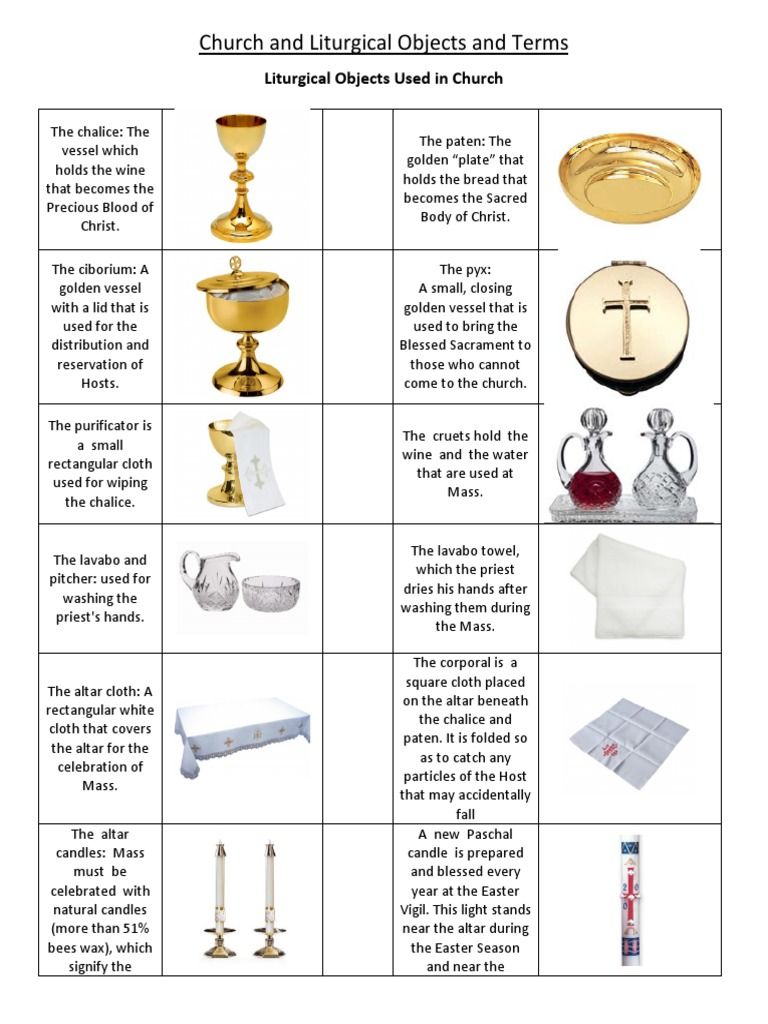
On the altar, the chalice and paten gleam like fragments of heaven itself. The chalice, cradling the Blood of Christ, is a cup of paradox—its gold and jewels speak of royalty, yet its contents are the humblest of gifts: wine, transformed into the very life of God. The paten, bearing the Host, is a mirror of the divine, its surface reflecting not the world but the face of the Savior. Together, they are the instruments of the Eucharist, the sacred alchemy that turns bread and wine into the Body and Blood of Christ.
Their preparation is a ritual of reverence. The priest’s hands, washed and anointed, lift the vessels with the care of a mother cradling her child. The linen purificator, the corporal spread beneath them—every detail is a sign of the sacredness of the moment. When the chalice is raised, when the paten is elevated, it is not just an act of worship; it is an encounter with the divine, a moment where time stands still and eternity breaks through.
The Processional Cross: The Banner of the Victorious
At the head of every procession, the processional cross marches forward, its banner snapping in the breeze like a war standard. It is not merely a symbol; it is a declaration—a reminder that the cross is not just an instrument of suffering but the triumph of love over death. The cross leads the way, its shadow stretching across the nave, a silent herald of the victory that awaits at the end of the journey.
The cross is carried with solemnity, its weight borne not just by the server’s hands but by the faith of the entire congregation. As it passes, the faithful bow their heads, a gesture of homage to the One who gave His life upon it. The cross is the heart of the liturgy, the axis around which all else revolves. Without it, the procession is just a march; with it, it becomes a pilgrimage, a journey toward the heart of God.
The Sanctuary Lamp: The Eternal Flame of Presence
In the hush of the sanctuary, a single flame flickers, suspended in a glass vessel like a captured star. The sanctuary lamp is not just a light; it is a sentinel, a perpetual reminder that the Lord is present, even in the darkest night. Its glow is a beacon, a silent prayer that pierces the shadows and guides the faithful home.
The lamp’s oil, carefully tended, burns with a steady flame—a symbol of the unchanging nature of God. When the lamp is extinguished, it is a sign of absence; when it is relit, the presence of the divine is affirmed. It is a small thing, this flickering light, yet it holds the power to transform a space into a sacred precinct, a place where heaven and earth meet.

