

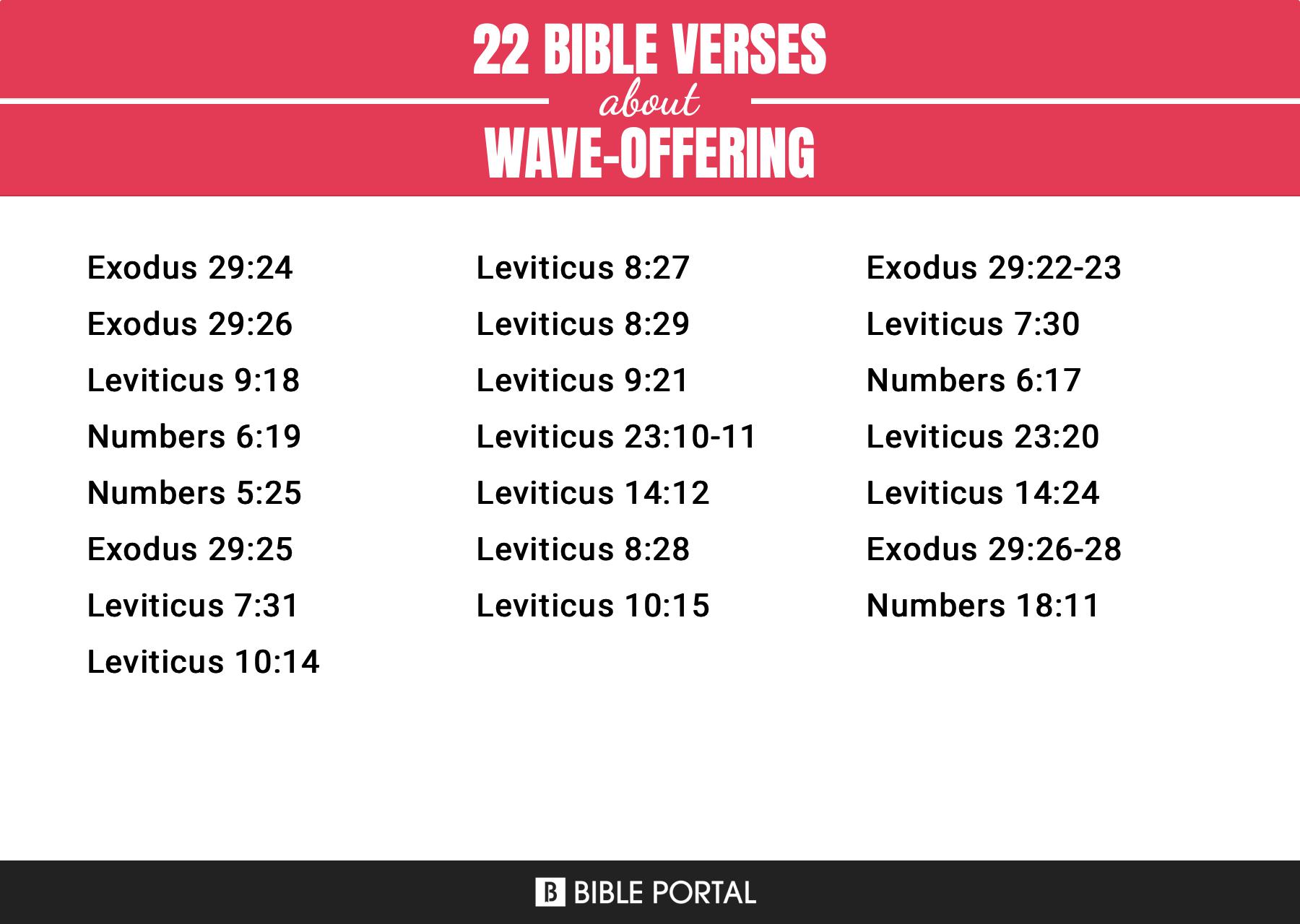
The concept of the wave offering, embedded within the sacred texts of the Bible, beckons for deeper scrutiny. More than a mere ritual, this offering represents an intriguing amalgamation of gratitude, community, and divine acknowledgment. To comprehend its significance, we must navigate the socio-religious landscapes of ancient Israel, unveiling the layers of meaning contained within this unique act of worship.
The wave offering, known as “Tenuphah” in Hebrew, emerges as a distinct act among the myriad of sacrificial practices delineated in Levitical law. It primarily manifests during the presentation of certain types of sacrifices, especially those associated with the consecration of priests and offerings on significant agricultural festivals. But what does it mean to “wave” an offering before God? This act is not merely a physical motion; it symbolizes the transference of dedication. The worshiper, through this gesture, elevates their gift—often unleavened bread or agricultural produce—offering it up to the Almighty in an almost reverential salute, signifying both honor and surrender.
In investigating the cultural implications of the wave offering, one discovers it is far more than an isolated ritual. It is an invitation to participate in the divine narrative. During communal festivals, such as the Feast of Weeks or Passover, the wave offering reinforced the bond between God and His people. It served as a visual and tactile affirmation of shared faith and collective identity. Indeed, within the architectural precincts of the Tabernacle, such acts transformed the physical landscape into an ethereal space where the sacred and the mundane intersected.
In the ceremonial context, priests played a pivotal role. As mediators between God and the Israelites, their actions during the wave offering were laden with significance. They not only performed the ritual but also articulated the community’s relationship with God. The act of waving the offering mirrored a larger cosmic principle: just as the physical world belongs to God, so too do the gifts of the harvest. This sacred acknowledgment disrupted the natural egoism of accumulation, fostering a spirit of generosity and recognition of divine providence.
Furthermore, one cannot ignore the metaphorical resonance of the wave offering. Picture, for a moment, the undulating movement of the offering. It rises, falls, and dances in the air. This dynamic motion evokes a shift in perspective, prompting us to consider the transient nature of our own contributions. The act itself becomes a metaphor for life’s ebb and flow; our offerings, be they financial, emotional, or spiritual, require dynamic engagement with the divine and our community. In offering something to God, we engage in a continuous cycle of giving and receiving, forming a bridge of communication that transcends the boundaries of the sacred and secular.
Moreover, we must address the inclusivity of the wave offering. Whereas many sacrificial rites were confined to specific demographics, the wave offering extended its reach. Both foreigners and native Israelites participated alike, indicating a divine welcome mat to those who sought communion with God. In an era often mired in division, this aspect of the wave offering invites contemporary reflections on how this ancient practice may inspire a more inclusive approach to faith today.
This act also embodies the idea of gratitude. Whether aesthetically expressed through the freshness of newly harvested grain or the crispness of baked loaves, the wave offering encapsulates the essence of thankfulness. It vocalizes a fundamental truth: all gifts come from the Creator. This paradigm shifts the focus from entitlement to appreciation, encouraging individuals and communities to recognize their interconnectedness. Such a realization fosters humility and reverence, proving essential in our modern times where the ethos of individualism often overshadows communal responsibility.
The theological implications of the wave offering extend to considerations of atonement and reconciliation as well. In ancient Israel, these offerings were integral during the sacrificial system, symbolizing both acknowledgment of sin and divine compassion. The act of waving could, therefore, be interpreted as a yearning for restoration, as the worshipper beseeches forgiveness and transformation. Today, this raises vital questions: how do our own offerings—of time, resources, and spirit—facilitate personal reconnection and collective healing within our communities?
As we contemplate the wave offering, we encounter an invitation; a call to reconsider how we approach our own offerings to God and to one another. Perhaps we are urged to infuse our lives with similar gestures of gratitude and community. Just as the wave offering was more than an act of cultural significance, it can serve as a template for how we might cultivate relationships imbued with respect, reciprocity, and love.
In conclusion, the wave offering embodies an intricate blend of ritual and meaning, extending far beyond its historical context. This vibrant practice offers a lens through which to examine our lives and our relationship with the divine and each other. The compelling narrative interwoven within the wave offering compels us to act with intention, appreciation, and a fervent desire for inclusivity, ultimately guiding us toward a more holistic understanding of community and faith within our contemporary reality.

