

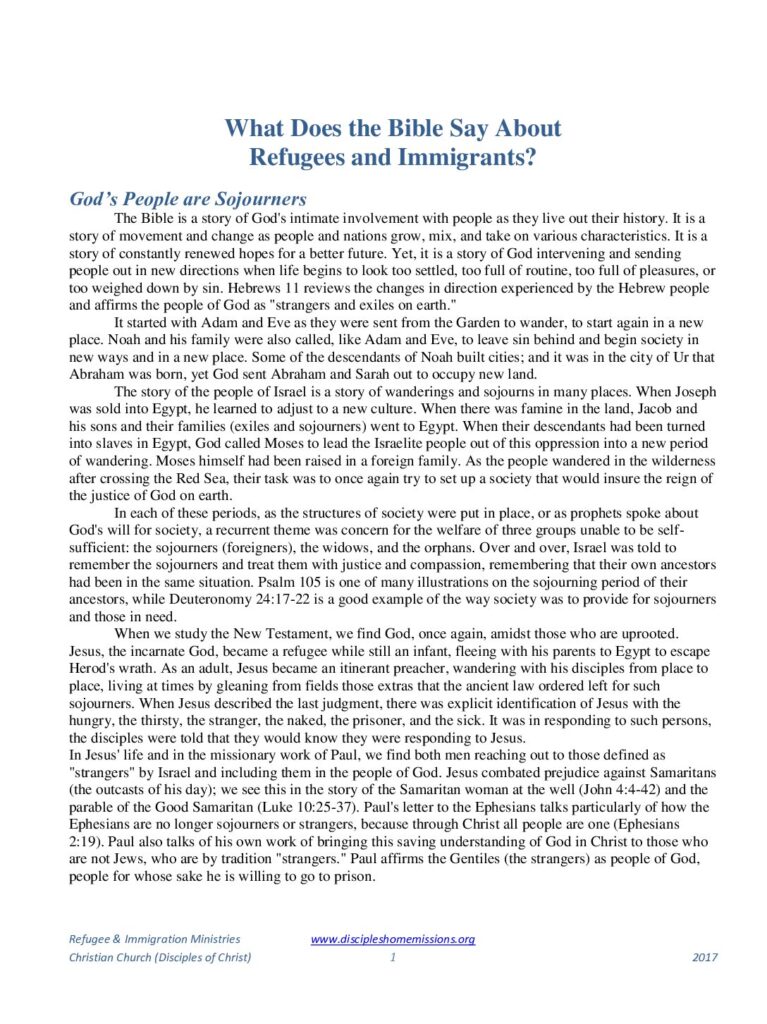
The concept of migration, steeped in complexity and steeped in the human experience, is as old as humanity itself. Throughout the annals of history, immigrants and refugees have traversed borders, driven by the yearning for safety, sustenance, and a place to belong. In the sacred pages of the Bible, the dialogue surrounding immigrants and refugees is profound and insistent, beckoning for empathy, compassion, and understanding from all who seek to follow its teachings.
In the Old Testament, the narrative of the Israelites offers a rich tapestry from which to glean insights about the plight of strangers and sojourners. The story of the Exodus serves as a primary motif—the Israelites, fleeing oppression, wander the wilderness in search of a Promised Land. This journey is emblematic of countless others who have sought refuge and safety, resonating deeply with modern-day refugees. The biblical phrase “You shall love the stranger” (Deuteronomy 10:19) encapsulates a profound moral imperative. Here, love is not merely a sentiment but an actionable commitment, urging believers to extend kindness and hospitality to those who are often marginalized.
Furthermore, the Bible illustrates a societal obligation towards immigrants through laws that articulate protection and justice. In Leviticus 19:34, it is stated, “The foreigner residing among you must be treated as your native-born. Love them as yourself.” This clarion call for equality underpins an essential tenet of faith—recognition that every individual, regardless of origin, bears an inherent dignity and is deserving of respect. It erases the metaphorical boundaries that separate ‘us’ from ‘them’ and enshrines the idea that community and kinship extend beyond ethnic lines.
As the New Testament unfolds, the teachings of Jesus further illuminate the significance of compassion towards the disadvantaged. In Matthew 25:35, Jesus proclaims, “For I was hungry and you gave me something to eat, I was thirsty and you gave me something to drink, I was a stranger and you invited me in.” Here, the call to welcome the stranger transforms into a divine mandate; to neglect the refugee is not merely an oversight—it’s a moral failing. In this context, the act of compassion morphs into a sacrament, a holy communion with those displaced and seeking solace.
Moreover, the parable of the Good Samaritan serves as an exemplar of active compassion. It challenges those who would pass by a suffering neighbor on the road of life. The Samaritan diverges from societal norms to assist a wounded traveler, unearthing a piercing truth; that our humanity is measured not by our origins but by our actions, and the borders we draw are often self-imposed.
In an increasingly globalized world, the biblical discourse on immigration and refugees echoes with urgency. The lessons drawn from scripture implore contemporary societies to navigate these waters with grace and understanding. Every story of displacement is woven with threads of hardship, resilience, and the audacious search for hope. As individuals and communities grapple with issues of migration, the divine call to act justly places a moral compass in hand, guiding towards mercy and solidarity.
Ultimately, to engage with the biblical perspective on immigrants and refugees is to embark on a journey of empathy, a pilgrimage towards shared humanity. It’s a reminder that every person, whether they bear the label of immigrant or citizen, is part of the larger mosaic of life, unique yet united in the common quest for dignity and belonging. This scriptural reflection invites not only contemplation but also action—a call to forge bonds that transcend borders, to cultivate a sanctuary for those wandering in search of home.

