

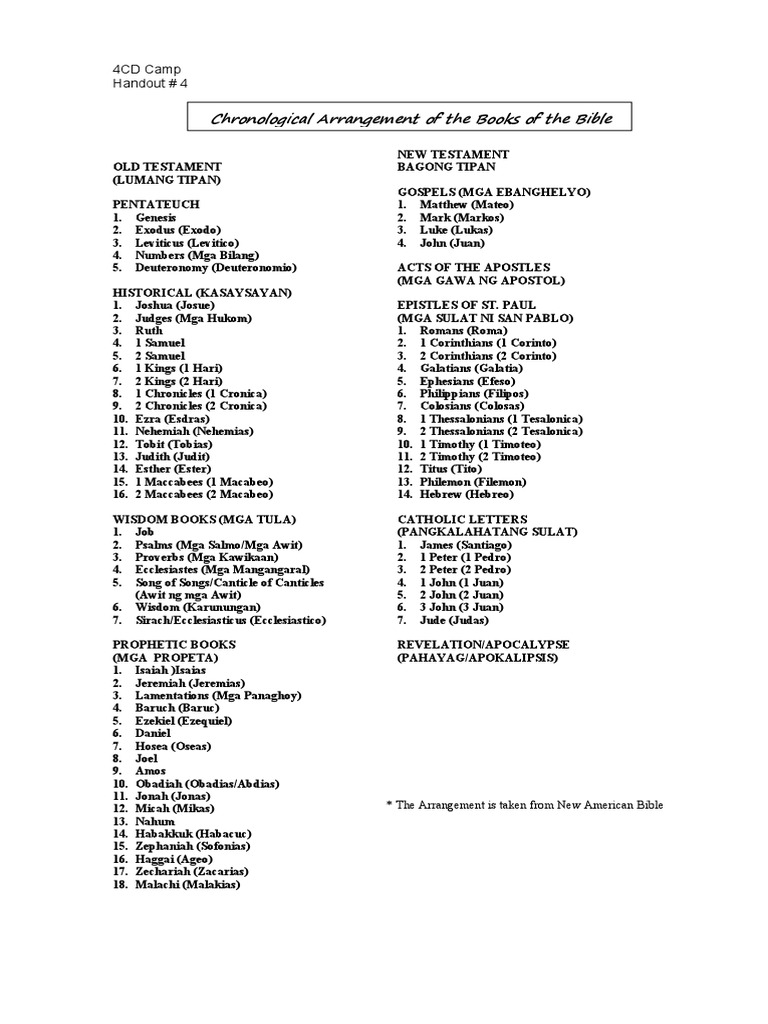
The Bible, a tome revered by billions, encapsulates both the essence of spirituality and the intricacies of human experience. Its content is a patchwork of narratives, laws, poetry, and prophesies, intertwining the lives of countless individuals across epochs. Yet, a common conundrum arises: what is the chronological order of these diverse texts? Understanding this sequence not only enhances comprehension but also unveils the deeper spiritual and historical context of the biblical narrative. This exploration invites readers into a labyrinth of faith, history, and literary artistry.
To embark on the journey through the chronological order of the Bible, one must first recognize that the texts do not unfold in a linear fashion. The Bible comprises two primary segments: the Old Testament and the New Testament. Many Christians see the Old Testament as a foundational narrative leading to the New Testament’s culmination in the life and teachings of Jesus Christ. Thus, the Old Testament must be our starting point.
The Old Testament begins with the creation narratives found in the Book of Genesis. Here, we encounter the majestic creation of the universe, the introduction of humankind, and the formation of key figures: Adam and Eve. These stories serve as a prelude to humanity’s tumultuous relationship with the divine—a theme that resonates throughout the text. Following the creation, readers traverse the stories of the patriarchs, including Abraham, Isaac, Jacob, and Joseph, which span from Genesis 12 to Genesis 50. These narratives are not mere familial chronicles; they highlight God’s covenant with humanity and set the stage for Israel’s formation.
The subsequent books present the saga of Israel’s descent into Egypt, as recounted in Exodus, and their ultimate liberation under Moses’ leadership. This exodus, marked by divine ordinances and mystical experiences, is a pivotal moment in the Old Testament, establishing the foundations of Jewish law and worship. The story continues through Leviticus, Numbers, and Deuteronomy, which articulate the laws and guidelines that would govern the Israelites, delineating their unique covenant with God.
As we progress into the historical books, beginnings of conquest and settlement emerge. The Book of Joshua narrates Israel’s entrance into the Promised Land, while Judges chronicles the tumultuous period that follows—highlighting cycles of sin, oppression, and deliverance. The books of Samuel and Kings further explore the establishment and eventual fragmentation of the monarchy, emphasizing figures like Saul, David, and Solomon. These characters embody a rich tapestry of moral complexities and divine interactions, leading to the eventual division of the kingdom into Israel and Judah.
As Assyria invaded Israel and Babylon besieged Judah, the prophetic texts emerge as a response to the crises of the times. Prophets such as Isaiah, Jeremiah, and Ezekiel not only prophesied doom but also offered hope, articulating visions of restoration and the coming of a Messianic figure. The minor prophets, ranging from Hosea to Malachi, further underscore this theme, encapsulating profound spiritual insight amid social injustice and moral decay.
The Old Testament narrative ultimately pivots into the New Testament, which chronicles the life, death, and resurrection of Jesus Christ, transitioning from the prophetic expectations to their fulfillment. The Gospels—Matthew, Mark, Luke, and John—each provide a distinct perspective on Jesus’ ministry. This segmented storytelling invites exploration of diverse theological themes, from the Kingdom of God to the nature of love and sacrifice. The Acts of the Apostles chronicles the early Christian community’s formation and expansion, showcasing not only the challenges faced by the fledgling movement but also divine intervention that guided its mission.
As the letters of Paul and other apostles come into play, the epistolary tradition enhances our understanding of early Christianity’s struggles and triumphs. These writings provide encouragement, doctrine, and counsel to burgeoning communities across the Roman Empire, revealing a kaleidoscope of theological discourse that continues to reverberate today. The culmination of the New Testament in the Book of Revelation presents a prophetic conclusion, envisioning ultimate reconciliation between humanity and the divine—a fitting capstone to the biblical narrative’s overarching arc.
In comprehending the chronological order of the Bible, one can discern the seamless interplay between historical events and spiritual truths. This sequence captures the essence of humanity’s quest for existential understanding, weaving together threads of hope amidst despair while elucidating moral complexities. It reflects a fascination that transcends mere literary exploration, inviting contemplation of divine mysteries and human experiences.
Ultimately, the Bible’s chronological order is more than a timeline; it is a vibrant tapestry that encompasses the sacred and the secular, the prophetic and the pastoral. By engaging with this narrative structure, readers not only enhance their understanding of scripture but also invite an introspective journey into the very essence of faith and existence. It is this perennial relevance that captivates, challenges, and compels generations to scrutinize their relationship with the divine, while illuminating the timeless pursuit of grace, redemption, and love.

