

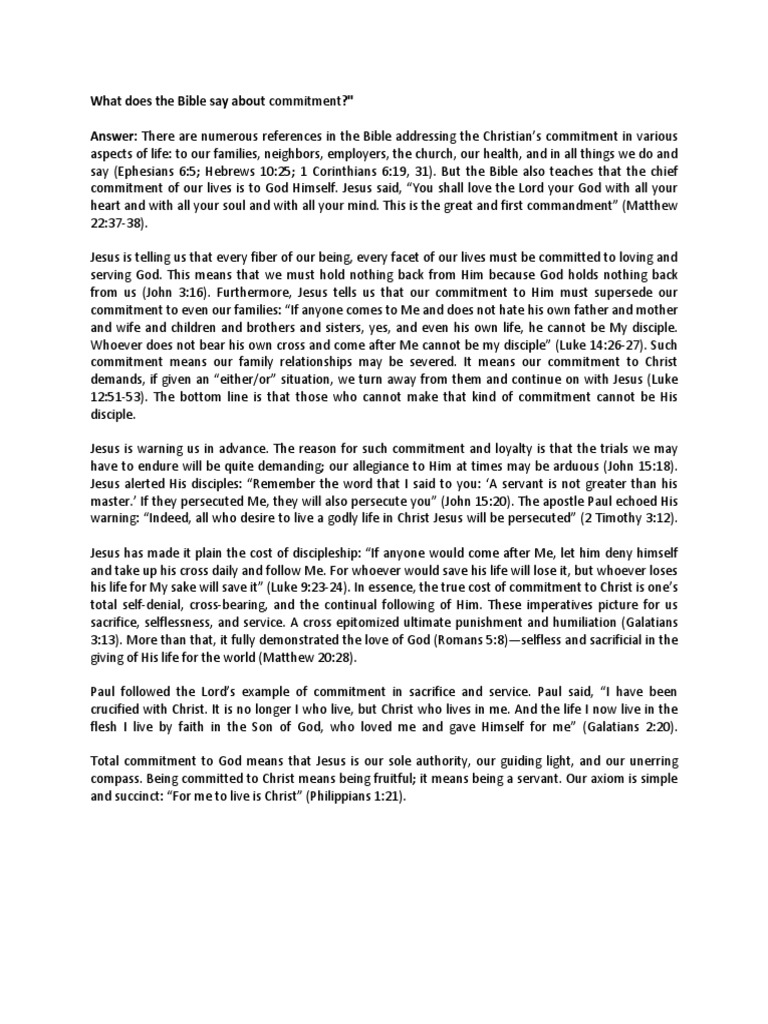
The concept of commitment, as illuminated by biblical texts, transcends mere obligation; it embodies a profound allegiance to both the divine and to fellow beings. Commitment, in the spiritual sense, is often likened to a tapestry—woven with threads of trust, perseverance, and grace. Each strand represents a promise made, an agreement sealed, and a step taken in faith. The intricate design that emerges reveals the beauty of steadfast devotion and the transformational power it can wield in one’s life.
At its core, biblical commitment begins with the unyielding relationship between God and humanity. Scriptures recount how God’s covenant with His people is a testament to unwavering fidelity. In essence, these divine pledges serve as a foundational template for human relationships. Consider the profound declaration found in Deuteronomy 7:9, which states, “Know therefore that the Lord your God is God; He is the faithful God, keeping His covenant of love to a thousand generations of those who love Him and keep His commandments.” Here, commitment is understood not just as a one-time occurrence but as an enduring pact, echoing through generations.
One of the most compelling illustrations of commitment manifests through the character of Ruth. In the Book of Ruth, her declaration to Naomi, “Where you go, I will go, and where you stay, I will stay,” exemplifies the very essence of loyalty and sacrificial love. Ruth’s commitment transcends cultural boundaries and social norms; it is a resolute choice to stand by her mother-in-law, even in the face of uncertainty. This poignant narrative serves as a parable for modern-day commitments, suggesting that true allegiance often requires stepping into the unknown, driven by the bonds of love and faith.
Moreover, the New Testament offers a profound exploration of commitment through the teachings of Jesus. His invitation to “deny oneself and take up one’s cross” is a clarion call to a life of sacrificial commitment. This metaphorical cross represents the burdens, trials, and responsibilities one willingly undertakes as part of spiritual devotion. It beckons believers to both endure and embrace their challenges, thus reinforcing the idea that commitment is not merely about comfort; it is often a crucible for character and faith.
Commitment also reverberates within community dynamics, where the call to love one another is paramount. In John 13:34, Jesus commands, “A new command I give you: Love one another. As I have loved you, so you must love one another.” The implication here is profound; true commitment within relationships is exhibited through selfless love and service. It is a directive to elevate others’ needs, resembling the image of a gardener nurturing a garden—enabling flowers to bloom through attentive care and support.
As one delves deeper into the biblical narrative, it becomes evident that commitment is often accompanied by trials. James 1:12 proclaims, “Blessed is the one who perseveres under trial because, having stood the test, that person will receive the crown of life that the Lord has promised to those who love him.” This verse elucidates that commitment is not exempt from adversity; rather, it is during tribulations that the purity of one’s commitment is tested and ultimately refined.
In conclusion, biblical stories of commitment present a multifaceted exploration of loyalty, faith, and sacrificial love. They urge readers to understand commitment as a dynamic force capable of shaping one’s life and relationships profoundly. Like the strongest of tapestries, woven with diverse threads of experience, commitment enriches both the individual and the community, forwarding a legacy of unwavering love and steadfast faith that resonates through time. It is a divine dance of fidelity—a harmony of promises made, burdens shared, and lives transformed.

