

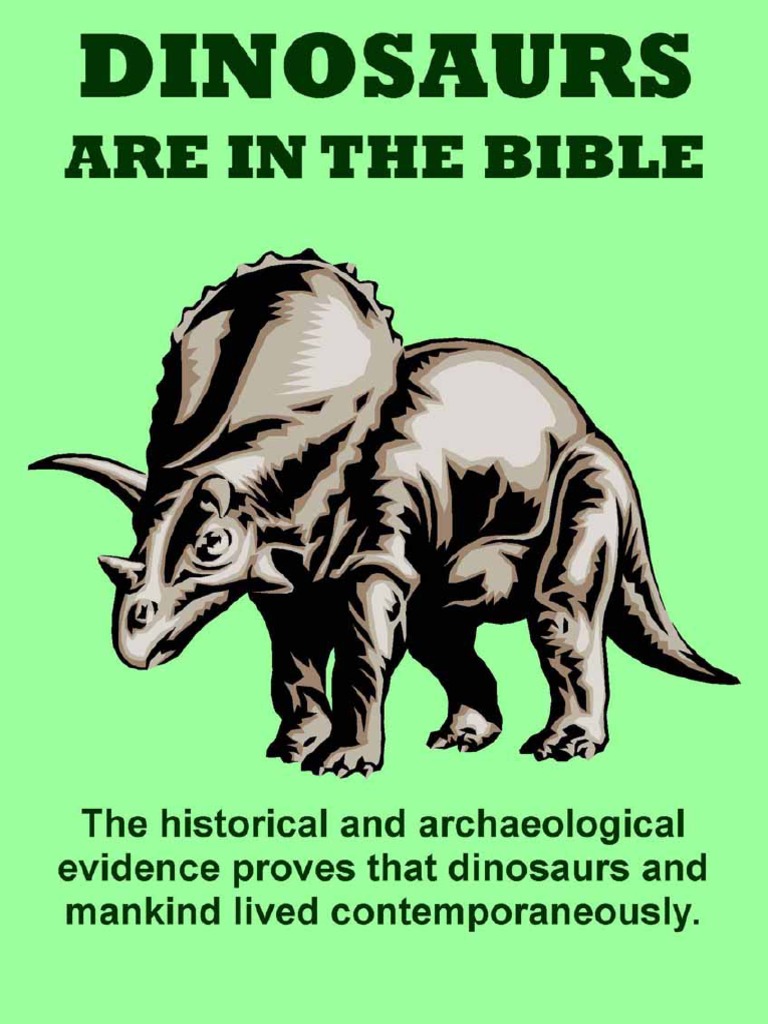
What if the ancient texts, often perceived solely as spiritual guides, actually held cryptic clues about the colossal reptiles known as dinosaurs? This playful question invites a reexamination of references within the Bible, prompting readers to ponder the intriguing possibility that these magnificent creatures may have roamed the earth alongside early humans, or at least existed within the imagination of biblical narratives.
Firstly, one must consider the vivid descriptions of creatures within the scriptures. The Book of Job, for instance, features the Behemoth, a colossal entity representing immense strength and size. Job 40:15-24 describes it as a creature that “eats grass like an ox” and possesses a tail “like a cedar tree.” Such imagery evokes visions that could correlate with the massive size of certain dinosaur species. The sheer grandeur implied in these passages suggests a creature unmatched by any contemporary animal, begging the question: could this be a metaphorical representation of dinosaurs?
Moreover, other descriptions lead to tantalizing speculation. The Leviathan, another formidable beast mentioned in Job, brings forth a vivid image of a powerful sea creature with significant strength and an impenetrable exterior. Traditionally interpreted as a crocodile or whale, one could argue that the attributes ascribed to the Leviathan echo those of prehistoric marine reptiles, suggesting that the ancient authors were perhaps inspired by real-life remnants of such creatures found in their world.
To further explore this fascinating intersection of religion and paleontology, one might examine the potential implications of the creation narrative in Genesis. The biblical account describes the creation of animals and humans over a period spanning six days, culminating in the formation of mankind on the sixth day. Critics of a literal interpretation often raise concerns about the timeline suggested by both scripture and scientific findings regarding when dinosaurs existed. Could the ‘days’ of creation be allegorical, allowing for a much broader temporal interpretation? This perspective not only harmonizes the biblical account with tangible evidence from the fossil record but also enhances the theological understanding of creation as a potentially expansive, rather than a narrowly defined, phenomenon.
Furthermore, the question of nomenclature surfaces. The term “dinosaur” was coined in the 19th century, long after the texts were composed. The absence of the term within biblical literature could lead to misconceptions about the presence or non-presence of such creatures in Biblical times. Dinosaurs, are, in fact, a part of the grand narrative of creation, even if not directly named. Ancient peoples may have encountered fossils, inferring their existence through oral tradition, alluded to only in veiled references.
In conclusion, while the Bible does not explicitly mention dinosaurs as we define them today, its rich tapestry of imagery, coupled with the profound narratives of creation, invites readers to reimagine the biblical account in light of paleontological discoveries. This intermingling of faith and science propels the imagination, suggesting that dinosaurs, in one form or another, have always been a part of the story of our existence on Earth. Whether taken literally or metaphorically, the connections forged between these awe-inspiring creatures and biblical texts certainly ignite a whimsical challenge to conventional interpretations. What if, after all, the message of the scriptures extends beyond the literal, encompassing the wonders of a world that once was?

