

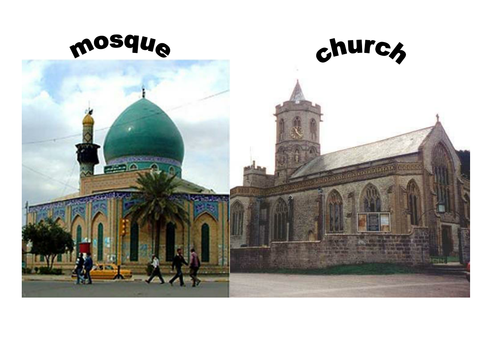
There’s a quiet magic in standing between two sacred spaces—one where the air hums with Gregorian chants, and another where the scent of incense mingles with the murmur of prayer. Churches and mosques, though both houses of worship, are worlds apart in architecture, ritual, and the very essence of their spiritual expression. Yet, what draws us to compare them isn’t just their differences, but the way they reflect the cultures, histories, and philosophies that birthed them. To understand these spaces is to glimpse the soul of the communities they serve.
The Foundations of Worship: Architecture as a Mirror of Belief
Step into a Gothic cathedral, and you’re enveloped by a forest of towering spires, where light fractures through stained glass like divine fragments. The verticality isn’t accidental—it’s a deliberate reach toward heaven, a physical manifestation of the Christian belief in transcendence. The cruciform floor plan, with its long nave and transepts, isn’t just practical; it’s a symbolic cross, a reminder of sacrifice and redemption.
Now, enter a mosque. The first thing that strikes you is the absence of imagery. No statues, no paintings—just intricate calligraphy adorning the walls, verses from the Quran rendered in arabesque perfection. The dome, often a defining feature, isn’t just an architectural flourish; it symbolizes the vault of heaven, while the minaret—a slender, towering spire—serves as a beacon, calling the faithful to prayer. Unlike the Christian emphasis on vertical ascent, Islamic architecture often prioritizes horizontal expansion, reflecting a communal ethos where worship is both personal and collective.
Sacred Sounds: The Language of Prayer and Praise
The soundscape of a church is a symphony of voices and instruments. The organ’s thunderous chords, the choir’s harmonized anthems, the priest’s resonant recitations—each element is designed to elevate the soul. Even silence plays a role; the hush after a hymn can feel like a sacred pause, a moment of reflection before the next swell of music.
In a mosque, sound is more intimate, more rhythmic. The adhan, the call to prayer, isn’t sung in harmony but in a haunting, melodic cadence that varies by region. The imam’s recitation of the Quran isn’t accompanied by instruments; the human voice alone carries the weight of divine words. The rhythm of prayer—five times a day—creates a pulse, a heartbeat that synchronizes an entire community. Where churches often blend music and liturgy, mosques let the spoken word take center stage, a testament to the primacy of the Quran as the literal word of God.
Rituals of Passage: How Faith Marks Life’s Milestones
Baptism, first communion, confirmation, marriage—each sacrament in Christianity is a public declaration of faith, often steeped in symbolism. Water, bread, oil—these aren’t just elements; they’re vessels of grace. The rituals are deeply personal yet communal, binding individuals to the larger body of the church.
Islamic rituals are no less profound, but they unfold with a different cadence. The shahada, the declaration of faith, is the cornerstone of a Muslim’s identity. Circumcision, though not a religious obligation, is often celebrated as a communal rite. Marriage in Islam is a contract, a social and spiritual bond where the couple’s families play a pivotal role. Even death is marked by simplicity—burial within 24 hours, without embalming, in a shroud, underscoring the Islamic belief in the equality of all before God. Where Christianity often weaves ritual into the fabric of daily life, Islam embeds it into the rhythm of time itself.
The Role of Community: Fellowship vs. Ummah
In a church, community is often built around shared worship, potlucks, and volunteer work. The pews aren’t just seats; they’re a gathering of souls united by faith. The priest or pastor acts as a shepherd, guiding the flock through sermons and sacraments. The sense of belonging is palpable, but it’s often tied to the physical space of the church.
Mosques, by contrast, are hubs of both spiritual and social life. The term *ummah*—the global Muslim community—reflects a bond that transcends geography. Friday prayers aren’t just a religious obligation; they’re a weekly reaffirmation of this unity. The mosque serves as a school, a court, a shelter, and a place of learning. Where churches often have a hierarchical structure, mosques emphasize collective responsibility, with imams and scholars serving as guides rather than absolute authorities.
Art and Iconography: The Sacred and the Forbidden
Christian art is a feast for the eyes. Frescoes, sculptures, and mosaics depict saints, angels, and biblical scenes, each brushstroke a meditation on the divine. The crucifix, with its tortured figure, isn’t just a symbol; it’s a reminder of sacrifice and love. Even the humble candle, flickering in the darkness, becomes a metaphor for the soul’s journey toward light.
Islamic art, on the other hand, is a dance of abstraction. Geometric patterns, arabesques, and calligraphy weave together in infinite repetition, a visual representation of the infinite nature of God. The absence of figurative art isn’t a limitation; it’s a liberation, allowing the mind to focus on the essence of the divine rather than its representation. Where Christianity uses art to tell stories, Islam uses it to evoke a sense of awe and submission.
Gender and Space: Inclusivity and Separation
In many churches, seating is integrated, though traditional denominations may still observe gendered spaces in certain cultures. The pulpit, a symbol of authority, is often reserved for men, though this is changing in progressive circles. The role of women in leadership varies widely, from ordained pastors in some denominations to traditional roles in others.
Mosques, particularly in conservative traditions, often feature separate prayer areas for men and women, with women sometimes praying behind men or in balconies. This isn’t just a matter of space; it’s a reflection of cultural norms and interpretations of Islamic law. However, in many modern mosques, these divisions are becoming less rigid, with women taking on more active roles in leadership and education. The conversation around gender in both spaces is evolving, reflecting broader societal shifts.
The Future of Sacred Spaces: Adaptation and Innovation
Both churches and mosques are grappling with modernity. Some churches are embracing technology, live-streaming services to reach global audiences. Others are reimagining their spaces, turning them into community centers that host food drives, art exhibits, and even yoga classes. The line between sacred and secular is blurring, as faith communities seek to remain relevant in an increasingly secular world.
Mosques, too, are adapting. In urban centers, they’re becoming multi-functional, housing libraries, classrooms, and even gyms. The call to prayer is now often accompanied by apps that notify users of prayer times. Yet, despite these changes, the core purpose remains: to serve as a sanctuary, a place where the divine and the human intersect.
The fascination with churches and mosques isn’t just about their differences—it’s about what those differences reveal. They are, in many ways, the physical embodiments of two great traditions, each with its own language of faith, its own rhythm of worship, its own vision of the divine. To stand in both is to witness the extraordinary diversity of human spirituality—and to recognize, in the end, that all sacred spaces, no matter their form, are ultimately pointing toward the same ineffable mystery.

