

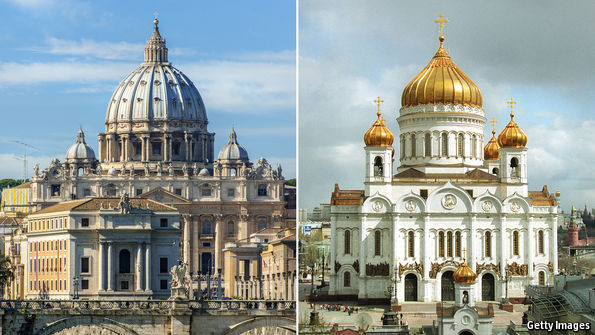
The great schism between the Orthodox and Catholic Churches is not merely a historical footnote—it is a living testament to the way faith can fracture along the fault lines of culture, politics, and theology. For centuries, pilgrims have stood before the same icons, recited the same creeds, and yet worshipped in ways that feel worlds apart. What compels this enduring fascination? Perhaps it is the mystery of how two branches of the same ancient tree could diverge so profoundly, or the quiet reverence with which each tradition preserves its identity. To understand their differences is to peer into the soul of Christianity itself.
The Unbroken Thread: Historical Roots and the Great Divide
The story begins not in a single moment of rupture, but in a slow unraveling of communion. By the 11th century, the Christian world had already stretched across empires, languages, and customs. The Roman Church, centered in the West, spoke Latin and wielded the sword of papal supremacy. The Eastern Church, rooted in Constantinople, thrived in Greek thought and imperial synergy. The final breach came in 1054, not with a single decree, but with mutual excommunications that echoed through the centuries like a church bell tolling in two different keys. The filioque controversy—whether the Holy Spirit proceeds from the Father alone or from the Father and the Son—was the theological spark, but the tinder was centuries of cultural and political divergence.
The Papal Question: Authority and the Weight of the Keys
At the heart of the divide lies the question of authority. The Catholic Church venerates the Pope as the Vicar of Christ, infallible in matters of faith and morals, a living monarch whose decrees bind the faithful like celestial law. The Orthodox Church, by contrast, rejects such centralized power. Instead, it embraces a conciliar model—synods of bishops gathering in council, their decisions emerging from consensus like a slow, sacred river. To the Catholic, this seems like a ship without a captain; to the Orthodox, it is the ancient way, untouched by the storms of papal ambition. The very air between them hums with the tension of who truly holds the keys to heaven.
Liturgy and the Senses: A Feast for the Soul
Step into a Byzantine Divine Liturgy, and the world dissolves into incense, chant, and flickering candlelight. The Orthodox service is a symphony of the senses—golden mosaics shimmering overhead, the scent of myrrh mingling with the cool stone, the slow, hypnotic rhythm of the priest’s movements. The Catholic Mass, particularly in its Tridentine form, is no less majestic, but it is a drama of words and gestures, a tightly choreographed ballet of priest and congregation. The Orthodox rite is an ocean of stillness; the Catholic, a river of structured flow. Both seek transcendence, but through different doorways—one through silence, the other through solemnity.
Icons and Sacraments: Windows to the Divine
The Orthodox venerate icons as windows to heaven, believing that the paint itself becomes a vessel for the holy. These sacred images are not mere representations but living presences, kissed, bowed before, and carried in processions. The Catholic Church, while honoring religious art, places greater emphasis on sacraments—seven sacred rites that are outward signs of inward grace. Baptism, Eucharist, Confirmation—each is a portal, a moment where the divine breaks into the mundane. The Orthodox see the sacraments as the very fabric of the Church; the Catholic, as its lifeblood. One tradition kneels before painted saints; the other receives the body of Christ on its tongue.
Fasting and Feasting: The Rhythm of Holiness
The Orthodox calendar is a labyrinth of fasts and feasts, a rhythm that shapes the soul like the seasons shape the earth. Forty days before Christmas, the Nativity Fast demands abstinence from meat, dairy, and even olive oil. Lent is a desert journey of self-denial, culminating in the Paschal vigil—a night of fire, water, and resurrection joy. The Catholic Church observes fasting too, but with less intensity, its disciplines more like gentle tides than raging storms. The Orthodox fast to purify the body as a temple; the Catholic fasts to sharpen the spirit for communion. One tradition starves to feast; the other feasts to starve.
Even in their celebrations, the two churches diverge. The Orthodox Easter, or Pascha, often falls weeks after the Catholic celebration, a celestial misalignment that feels like a deliberate act of defiance. The Catholic Easter is a sunrise service, bright and triumphant. The Orthodox Pascha is a midnight mystery, a darkness pierced by light, a resurrection that feels earned through suffering.
Theosis vs. Salvation: Two Paths to Union with God
The Orthodox speak of theosis—the idea that humans can become like God through divine energies, a process of deification. It is not about escaping the world but transfiguring it, like sunlight turning stone into gold. The Catholic tradition, while acknowledging sanctification, frames salvation more juridically: a legal transaction where Christ’s sacrifice pays humanity’s debt. The Orthodox see the cross as a cosmic victory; the Catholic, as a legal atonement. One tradition climbs the ladder of holiness; the other waits for the judge’s gavel to fall.
This difference is not academic. It shapes how each church views suffering, prayer, and even the nature of God. The Orthodox believe in a God who is love in essence, a fire that consumes yet does not destroy. The Catholic God is both judge and father, a paradox of wrath and mercy. To the Orthodox, theosis is the natural end of the Christian life. To the Catholic, salvation is the gift of grace, received through faith and sacrament.
Cultural Echoes: From Byzantium to Rome
The Orthodox Church is the heir of Byzantium, a civilization where church and state were one, where mosaics told stories in gold and lapis lazuli. Its theology is steeped in Greek philosophy, its liturgy a dialogue with the ancient world. The Catholic Church, born in the ruins of Rome, carries the weight of imperial ambition, its cathedrals reaching toward heaven like the spires of a new empire. The Orthodox cross is a symbol of suffering and victory; the Catholic cross, a reminder of sacrifice and redemption.
Even their calendars tell a story. The Orthodox still use the Julian calendar, a relic of antiquity, while the Catholic Church adopted the Gregorian reform in 1582. This means Orthodox Christmas often falls on January 7, a quiet rebellion against modernity. The Catholic Church, in its quest for precision, aligned itself with the stars. The Orthodox, in its devotion to tradition, remained tethered to the past.
The Modern Divide: Unity and the Longing for Reconciliation
In an age of globalization, the schism feels both archaic and inevitable. The Catholic Church, through Vatican II, sought to bridge the gap, inviting Orthodox observers to its councils and softening its stance on Eastern traditions. The Orthodox, however, remain wary of papal overreach, their identity forged in resistance. Yet, in quiet corners of the world—Ukraine, Lebanon, the diaspora—the two churches coexist, their differences softened by shared prayers and common enemies.
Some whisper of a future reunion, a healing of the ancient wound. But reunion would require more than theological compromise. It would demand that the Catholic Church surrender its claim to universal jurisdiction, and the Orthodox, their insistence on conciliar purity. It would require both to acknowledge that the other is not a heretic, but a sister church, flawed and holy in its own way.
The Fascination Endures
Why does this schism still captivate us? Perhaps because it reveals the paradox at the heart of Christianity: a faith that preaches unity but thrives in division. It is the story of how love can fracture, how truth can be sung in different keys, and how the divine can be sought in silence or in ritual. The Orthodox and Catholic Churches are not just institutions; they are living museums of faith, each preserving a piece of the Christian soul. To stand between them is to stand at the edge of a mystery—one that asks not for answers, but for wonder.

