

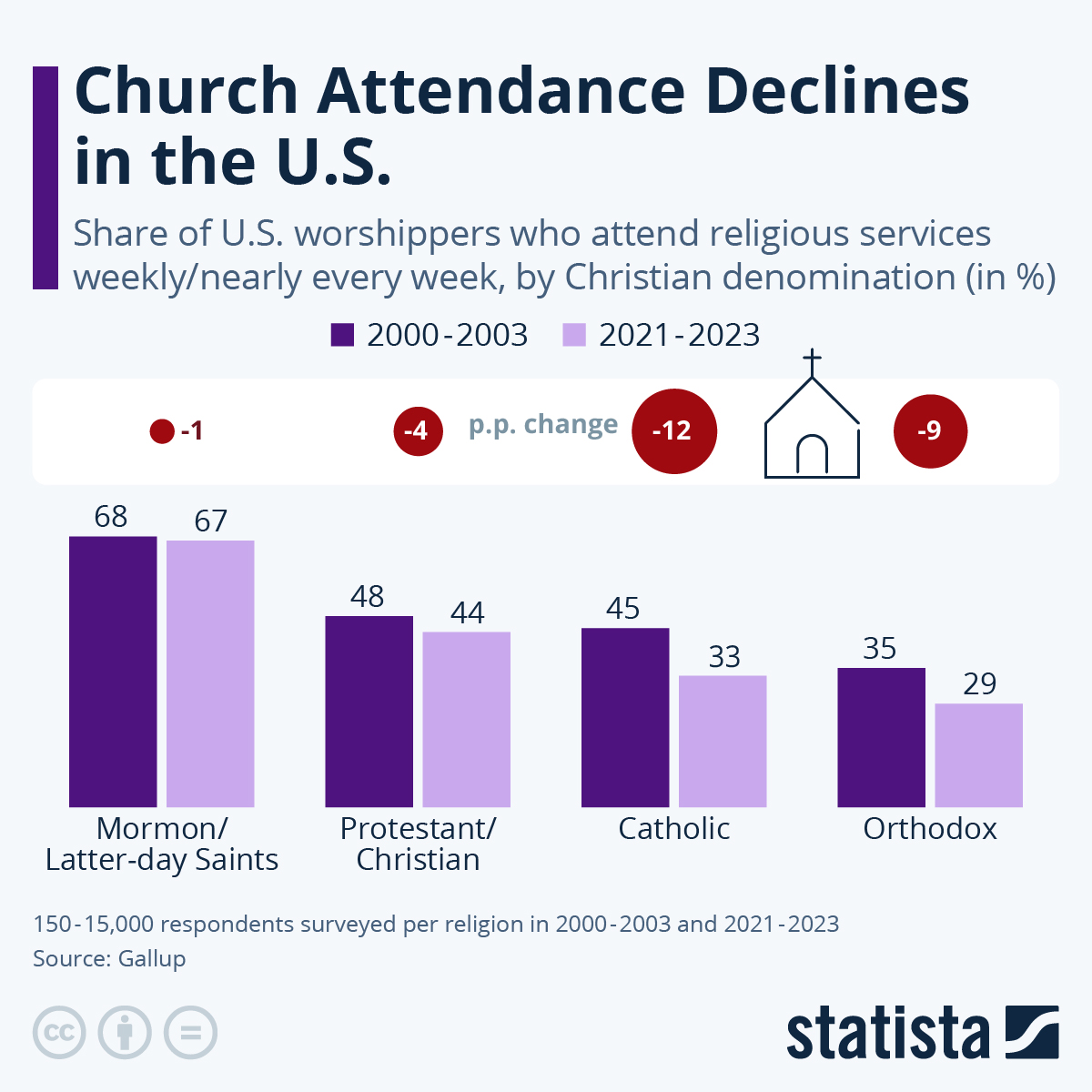
What if the pews of America’s churches were not just emptying, but whispering a secret that no one dares to name? As Easter approaches, a familiar ritual unfolds across the nation—families in their finest attire, choirs swelling with hymns, and pastors delivering sermons that have echoed through generations. Yet beneath the polished veneer of tradition, a quiet exodus is underway. Church attendance in the United States is slipping, not with a dramatic crash, but with the slow, insidious creep of a tide retreating from the shore. This isn’t just a statistical blip; it’s a cultural tremor, one that challenges the very foundations of community, faith, and belonging in modern America.
The Vanishing Congregation: A Puzzle Wrapped in Tradition
Picture this: a sanctuary bathed in golden light, the scent of polished wood and candle wax lingering in the air, the murmur of voices blending into a familiar hum. This scene, once a weekly staple for millions, now feels like a relic of a bygone era. The decline in church attendance isn’t merely a drop in numbers—it’s a transformation of the social fabric itself. What was once a cornerstone of American life is now contending with the relentless march of secularization, the allure of digital distractions, and a growing skepticism toward institutionalized religion.
But why now? After all, faith has been a steadfast companion to humanity for millennia. The answer may lie in the paradox of progress. As society advances, the role of the church has been forced to evolve—or risk obsolescence. The modern believer is no longer content with passive participation; they crave authenticity, relevance, and a faith that speaks to their lived experiences. When the pulpit feels like a monologue rather than a dialogue, when the message feels archaic rather than invigorating, the congregation dwindles—not out of malice, but out of necessity.
Digital Devotion: The Church’s New Rival
The smartphone in your pocket is more than a device; it’s a portal to infinite possibilities—and infinite distractions. For many, Sunday mornings are no longer reserved for hymns and sermons but for scrolling through endless feeds, binge-watching shows, or catching up on work. The church, once the unchallenged epicenter of community life, now competes with algorithms designed to hijack attention spans. This isn’t just a battle for time; it’s a battle for the soul of connection.
Yet, the digital age isn’t all doom and gloom for faith. Some churches have embraced technology, streaming services online, and creating virtual communities that transcend physical boundaries. But here’s the rub: digital engagement is a double-edged sword. It can democratize access to spiritual nourishment, but it can also dilute the sacredness of communal worship. Can a screen ever replicate the electric hum of a packed congregation, the shared laughter, the whispered prayers, the tangible sense of being part of something greater? The challenge isn’t just to adapt to technology but to wield it in a way that deepens, rather than diminishes, the spiritual experience.
The Millennial Exodus: Why the Young Are Walking Away
If the decline in church attendance were a slow leak, the exodus of millennials would be the floodgate swinging open. This generation, raised on a diet of individualism and skepticism, is increasingly viewing organized religion with a critical eye. For many, the church represents a relic of hypocrisy, a place where dogma trumps empathy and tradition stifles progress. Others simply don’t see the relevance of a 2,000-year-old institution in a world where answers are a Google search away.
But the millennial disengagement isn’t just about disillusionment—it’s about a search for meaning that the church hasn’t yet provided. They crave authenticity over ritual, action over passive observation. When the church fails to address social justice, climate change, or mental health with the urgency these issues demand, it risks becoming irrelevant. The question isn’t just why millennials are leaving, but whether the church is willing to reinvent itself to welcome them back—or if it will resign itself to becoming a museum of faith rather than a living, breathing community.
Cultural Shifts: The Church’s Identity Crisis
The decline in church attendance isn’t just a numbers game; it’s a reflection of deeper cultural shifts. America is no longer a monolith of religious devotion. The rise of the “nones”—those who identify as atheist, agnostic, or simply unaffiliated—has reshaped the spiritual landscape. For these individuals, faith is no longer a given; it’s a choice, one that must be justified in a world where science, reason, and personal experience often take precedence.
This isn’t to say that spirituality is dying—far from it. People are still searching for meaning, still seeking connection, still yearning for transcendence. But the channels through which they seek it are diversifying. Meditation apps, wellness retreats, and secular communities are filling the void left by traditional religious institutions. The church’s challenge is to ask itself: Is it clinging to outdated models of engagement, or is it evolving to meet the needs of a new generation of seekers?
The Leadership Paradox: Shepherds or Dinosaurs?
At the heart of the church’s struggle lies a leadership crisis. Many pastors and clergy were trained in an era when the pews were full, when the role of the church was unquestioned. But today’s spiritual landscape demands a different kind of leadership—one that is adaptable, empathetic, and willing to challenge the status quo. Too often, the church’s response to decline is to double down on tradition, as if clinging to the past will somehow reverse the tide. But tradition without relevance is just nostalgia, and nostalgia doesn’t fill empty pews.
The most effective leaders today are those who can bridge the gap between ancient wisdom and modern sensibilities. They are storytellers who can weave timeless truths into contemporary narratives. They are listeners who can hear the unspoken doubts and fears of their congregations. They are innovators who aren’t afraid to experiment with new forms of worship, community engagement, and outreach. The question isn’t whether the church can survive, but whether its leaders are willing to lead—or if they’ll be left behind by the very people they’re meant to serve.
Reinvention or Relic: The Church’s Ultimate Test
So, what’s the future of the church in America? Will it become a relic of a bygone era, a quaint reminder of a time when faith was unquestioned? Or will it reinvent itself, shedding the shackles of tradition to become a vibrant, dynamic force in modern life? The answer lies not in clinging to the past, but in embracing the future with open arms.
The church’s decline isn’t a death knell; it’s a wake-up call. It’s an invitation to ask hard questions, to confront uncomfortable truths, and to imagine a faith that is as alive today as it was two millennia ago. The path forward won’t be easy. It will require humility, courage, and a willingness to let go of what no longer serves. But if the church can rise to the challenge, it may yet find a way to fill its pews—not with the ghosts of tradition, but with the living, breathing souls of a new generation.
The question isn’t whether the church will survive. The question is whether it’s willing to change.

