

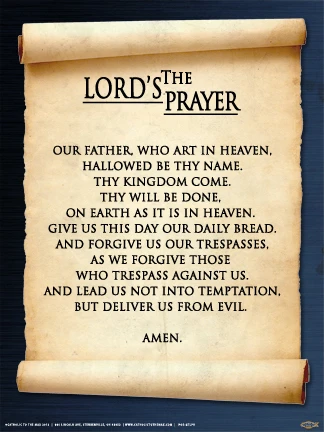
When the faint cadence of the Lord’s Prayer drifts through the nave, it feels like a luminous beacon threading the sacred silence of the church with an ethereal glow. It is not merely a collection of petitions; it is a living crucible where the divine and the human converge, inviting each worshipper into a profound dialogue of trust, repentance, and hope. In the heart of Christian liturgy, this prayer becomes the pulse that steadies the congregation, a compass that points both heavenward and earthward, urging the faithful toward metanoia and communal transformation.
A Sacred Liturgical Anchor
From the earliest moments of communal worship, the Lord’s Prayer has served as a liturgical anchor, tethering the faithful to the salvific narrative of Christ. In the Eucharist, its recitation creates a sacramental osmosis—words become vessels that carry the mysteries of incarnation, crucifixion, and resurrection into the present moment. The prayer’s rhythm mirrors the heartbeat of the church; each line a breath drawn in and released, a rhythmic communion that sustains the faithful as they navigate the tumultuous seas of everyday life. Its brevity belies its depth, offering a theurgical conduit through which believers can articulate their deepestlongings while remaining rooted in the apostolic tradition.
Guardians of the Divine Utterance
The church, as the custodians of sacred text, assumes the role of guardian, preserving the prayer’s theological integrity through centuries of doctrinal evolution. Church fathers, from Augustine to Aquinas, interpreted the petition “hallowed be thy name” as an ontological declaration—an affirmation that the sanctity of God is not confined to a distant realm but penetrates the very fabric of human experience. Through homilies, catechisms, and doctrinal statements, the institutional church has woven the prayer into the fabric of doctrinal formation, ensuring that each generation internalizes its eschatological promise. This guardianship is more than preservation; it is an active stewardship that invites the faithful to embody the prayer’s ethos in both private devotion and public witness.
The Theological Tapestry of “Our Father”
The opening address, “Our Father,” is a pivotal metaphor that redefines relationality in the divine economy. It is an anthropocosmic declaration, positioning humanity within a familial continuum that transcends bloodlines, culture, and nation. The phrase “who art in heaven” does not merely locate God in a distant realm; it evokes a pneumatological vision where the Holy Spirit hovers over the earthly tableau, imbuing the prayer with an otherworldly resonance. Each subsequent petition—such as “give us this day our daily bread”—functions as an existential petition for sustenance, both corporeal and spiritual, urging the faithful to recognize the interdependence of body, soul, and community. The prayer’s structure, therefore, becomes a liturgical map guiding believers through忏悔 (repentance), gratitude, and hopeful anticipation of the Kingdom.
The Prayer as a Mirror for Community and Mission
Within the ecclesial context, the Lord’s Prayer functions as a mirror reflecting the church’s collective identity and mission. When congregants utter “forgive us our trespasses as we forgive those who trespass against us,” they engage in a covenantal exchange that binds interpersonal forgiveness with divine mercy. This reciprocity creates a sacramental rhythm of grace, wherein the community is both recipient and conduit of pardon. The petition “lead us not into temptation” serves as a prophetic vigilance, urging the church to guard against complacency and moral drift. By internalizing these petitions, the faithful are equipped to become agents of reconciliation, extending the prayer’s transformative power beyond the sanctuary into the streets, workplaces, and homes where the gospel must be lived out.
Application in Worship and Daily Life
Applying the prayer’s meaning in contemporary worship requires an intentional synthesis of ritual and ethical praxis. Liturgists can embed the prayer’s petitions into the liturgical calendar, using each line as a thematic focus for preaching, hymnody, and communal reflection. In personal devotions, the prayer can be employed as a contemplative anchor—a rhythmic chant that quiets the mind and aligns the heart with the divine will. Moreover, the prayer’s emphasis on “daily bread” invites believers to engage in tangible acts of charity, fostering a culture of generosity that mirrors the providential care of the Father. By integrating these practices, the church not only preserves a sacred heritage but also animates it, ensuring that the prayer remains a vibrant conduit of faith.
Revitalizing the Ancient Petition
To revitalize the ancient petition in modern ecclesial life, congregations can embrace creative expressions that honor tradition while resonating with contemporary sensibilities. This might involve setting the prayer to diverse musical genres, incorporating visual iconography that depicts its metaphorical landscape, or facilitating small‑group dialogues that explore its implications for social justice. By presenting the prayer as a dynamic, living text, the church invites each generation to encounter its profound mystery afresh. The goal is to sustain a passionate engagement that honors the prayer’s sacred origins while illuminating its enduring relevance in an ever‑changing world.

